
Relational Calculus
- Relational calculus is a non-procedural query language. In the non-procedural query language, the user is concerned with the details of how to obtain the end results.
- The relational calculus tells what to do but never explains how to do it.
Types of Relational calculus:
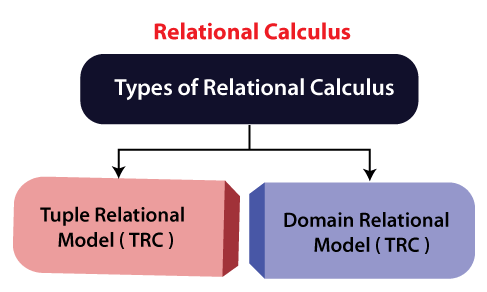
1. Tuple Relational Calculus (TRC)
- The tuple relational calculus is specified to select the tuples in a relation. In TRC, the filtering variable uses the tuples of a relation.
- The result of the relation can have one or more tuples.
Notation:
Where
T is the resulting tuples
P(T) is the condition used to fetch T.
For example:
OUTPUT: This query selects the tuples from the AUTHOR relation. It returns a tuple with 'name' from Author who has written an article on 'database'.
TRC (tuple relation calculus) can be quantified. In TRC, we can use Existential (∃) and Universal Quantifiers (∀).
For example:
Output: This query will yield the same result as the previous one.
2. Domain Relational Calculus (DRC)
- The second form of relation is known as Domain relational calculus. In domain relational calculus, filtering variable uses the domain of attributes.
- Domain relational calculus uses the same operators as tuple calculus. It uses logical connectives ∧ (and), ∨ (or), and ┓ (not).
- It uses Existential (∃) and Universal Quantifiers (∀) to bind the variable.
Notation:
Where
a1, a2 are attributes
P stands for formula built by inner attributes
For example:
Output: This query will yield the article, page, and subject from the relational javatpoint, where the subject is a database.
No comments:
Post a Comment
Thanks