CoderFunda
  • Home
  • About us
    • Contact Us
    • Disclaimer
    • Privacy Policy
    • About us
  • Home
  • Php
  • HTML
  • CSS
  • JavaScript
    • JavaScript
    • Jquery
    • JqueryUI
    • Stock
  • SQL
  • Vue.Js
  • Python
  • Wordpress
  • C++
    • C++
    • C
  • Laravel
    • Laravel
      • Overview
      • Namespaces
      • Middleware
      • Routing
      • Configuration
      • Application Structure
      • Installation
    • Overview
  • DBMS
    • DBMS
      • PL/SQL
      • SQLite
      • MongoDB
      • Cassandra
      • MySQL
      • Oracle
      • CouchDB
      • Neo4j
      • DB2
      • Quiz
    • Overview
  • Entertainment
    • TV Series Update
    • Movie Review
    • Movie Review
  • More
    • Vue. Js
    • Php Question
    • Php Interview Question
    • Laravel Interview Question
    • SQL Interview Question
    • IAS Interview Question
    • PCS Interview Question
    • Technology
    • Other

23 April, 2021

Laravel Mail Viewer

 Programing Coderfunda     April 23, 2021     Packages, php     No comments   


Laravel Mail Viewer

Laravel Mail Viewer is a package by Harish Toshniwal that enables you to view all the mailables in your Laravel application in a single place.

The Design and content team members often need access to the emails your app will be sending out to the users. This is a fairly simple package that makes it possible and tries to minimize developer dependency. By using this package, you can have a dedicated route to view all your mailables at a single place. Having shareable URLs to view the emails makes the team co-ordination more smooth.

I find this idea neat for developers too, because I am always looking through test emails to check out the email, and this package gives you an excellent way to reference all of them in one place.

The configuration is opt-in for the mailables that you want to appear, which means that any new emails you’d like to add you must explicitly define them. You can also constrain accessing mailables by the environment.

Here’s an example of what it looks like from the readme:

Here’s the configuration file at the time of writing:

<?php

return [
/*
|--------------------------------------------------------------------------
| Only the mailables registered here can be accessed using this package
|--------------------------------------------------------------------------
|
| You have to add the mailables including their dependencies
| in the following array. When asked for a mailable, the
| package will search it here for its definition.
|
| Eg: [ new OrderShipped(factory(Order::class)->create()) ]
|
*/

'mailables' => [],

/*
|--------------------------------------------------------------------------
| URL where you want to view the mails
|--------------------------------------------------------------------------
|
| This is the URL where you can view all the
| mailables registered above.
|
*/

'url' => 'mails',

/*
|--------------------------------------------------------------------------
| The environments in which the url should be accessible
|--------------------------------------------------------------------------
|
| If you don't want to use this package in production env
| at all, you can restrict that using this option
| rather than by using a middleware.
|
*/

'allowed_environments' => ['local', 'staging', 'testing'],

/*
|--------------------------------------------------------------------------
| Middlewares that should be applied to the URL
|--------------------------------------------------------------------------
|
| The value should be an array of fully qualified
| class names of the middleware classes.
|
| Eg: [Authenticate::class, CheckForMaintenanceMode::class]
| Don't forget to import the classes at the top!
|
*/

'middlewares' => [],
];

Read More
  • Share This:  
  •  Facebook
  •  Twitter
  •  Google+
  •  Stumble
  •  Digg

Laravel Proximage A Handy Package for Proxying Images

 Programing Coderfunda     April 23, 2021     Packages, php     No comments   


Laravel Proximage A Handy Package for Proxying Images

Laravel Proximage is a handy package by Ilya Sakovich for proxying images through images.weserve.nl. The package provides you convenience methods for generating URLs with a fluent API for image transformations.

If you want to cache your images via the images.weserve.nl proxy you can use the proxyimage() helper:

$imageUrl = 'ory.weserv.nl/lichtenstein.jpg';

>>> (string) proximage($imageUrl);
images.weserv.nl/?url=ory.weserv.nl/lichtenstein.jpg

If you wanted to resize the image, you can use the object’s width() method:

$imageUrl = 'ory.weserv.nl/lichtenstein.jpg';

>>> (string) proximage($imageUrl)->width(300);
images.weserv.nl/?url=ory.weserv.nl/lichtenstein.jpg&w=300

And finally, here’s an example of cropping and transforming images:

use Coderello\Proximage\Enums\Parameter;

proximage($imageUrl)
->crop(Parameter\CropAlignment::CENTER)
->transformation(Parameter\Transformation::SQUARE);

The images.weserv.nl service (that this package relies on) uses Cloudflare which means images are cached and delivered from over 150+ global datacenter. You can reference the official documentation for a complete list of transformations available as well as examples of how each setting affects the original source image.

To get complete installation instructions and the latest documentation of the Proximage Laravel package, check out the coderello/laravel-proximage GitHub repository. The Proximage package has tons of transformations available and makes for a quick and easy way to get image transformations within a Laravel project.

Read More
  • Share This:  
  •  Facebook
  •  Twitter
  •  Google+
  •  Stumble
  •  Digg

Laravel Database Hashing Package

 Programing Coderfunda     April 23, 2021     Packages, php     No comments   


Laravel Database Hashing Package

The Laravel Database Hashing package is a Laravel +5.5 package by Jack Noordhuis for automatically hashing database attributes. When enabled it automatically hashes data stored in model attributes.

It works by using a trait in combination with a class property:

<?php

use jacknoordhuis\database\hashing\traits\HasHashedAttributes;

class User extends Eloquent {
use HasHashedAttributes;

/**
* The attributes that should be hashed on save.
*
* @var array
*/
protected $hashing = [
"username_lookup",
];
}

Here’s an example from the README that demonstrates using a password as a salt modifier so that the hash can only be re-created when the user provides their valid password:

$user->username_lookup = $user->hashAttribute($username, $password);

You can then find the given user with the following query, using the DatabaseHashing facade provided by this package:

User::where(
"username_lookup",
"=",
\DatabaseHashing::create($request->get("username"), $request->get("password"))
);

I noticed that this package wasn’t ready for Laravel 5.7, which is the latest at the time of writing, but supports Laravel 5.5 and 5.6. If you want to help get this package ready for Laravel 5.7, you can learn about this package on GitHub at JackNoordhuis/laravel-database-hashing.

by : laravel-news

Read More
  • Share This:  
  •  Facebook
  •  Twitter
  •  Google+
  •  Stumble
  •  Digg

Laravel Tag Helper

 Programing Coderfunda     April 23, 2021     Packages, php     No comments   


Laravel Tag Helper

Laravel Tag Helper is a package by Marcel Pociot for adding powerful HTML tag helpers to your Laravel application. As a quick example of what this package can do, it ships with a few helpers out of the box.

You might have a typical form with a hidden CSRF input:

<form method="post" action="/profile">
@method('PUT')
@csrf
</form>

With the Laravel Tag Helper package you can write the same as follows:

<form csrf method="put">
{{-- ... --}}
</form>

The output will look like you’d expect:

<form method="post">
<input type="hidden" name="_method" value="PUT">
<input type="hidden" name="_token" value="csrf-token">
</form>

Another built-in helper is the link helper:

<a route="home">Home</a>
<a route="profile" :route-parameters="[$user->id()]">
Home
</a>

Custom Tag Helpers

The package works by registering tag helpers in a service provider’s boot() method. You can target specific elements and attributes that will trigger a process() call on the helper class during rendering.

Here’s an example from the project’s readme:

<?php

namespace BeyondCode\TagHelper\Helpers;

use BeyondCode\TagHelper\Helper;
use BeyondCode\TagHelper\Html\HtmlElement;

class CustomTagHelper extends Helper
{
protected $targetAttribute = 'custom';

protected $targetElement = 'div';

public function process(HtmlElement $element)
{
// Manipulate the DOM element
}
}

Within the process() method you can customize the HTML element tag. For example, if you had a custom element that you wanted to render as a link:

<?php

namespace BeyondCode\TagHelper\Helpers;

use BeyondCode\TagHelper\Helper;
use BeyondCode\TagHelper\Html\HtmlElement;

class CustomLink extends Helper
{
protected $targetElement = 'my-custom-link';

public function process(HtmlElement $element)
{
// Example
// <my-custom-link></my-custom-link>
$element->setTag('a');
$element->setAttribute('href', 'https://laravel-news.com');
}
}

Read More
  • Share This:  
  •  Facebook
  •  Twitter
  •  Google+
  •  Stumble
  •  Digg

PHP Semantic Versioning Helper

 Programing Coderfunda     April 23, 2021     Packages, php     No comments   


PHP Semantic Versioning Helper

SemVer is a semantic versioning helper library for PHP by Chris Kankiewicz with support for parsing, incrementing, and comparison.

Here’s the basic usage which initializes a SemVer\Version object:

use PHLAK\SemVer;

$version = new SemVer\Version(); // Initilializes to '0.1.0'

With an instance of SemVer\Version you can access individual values:

$version = new SemVer\Version('v1.2.3-beta.4+007');

echo $version; // '1.2.3-beta.4+007'
echo $version->major; // 1
echo $version->minor; // 2
echo $version->patch; // 3
echo $version->preRelease; // 'beta.4'
echo $version->build; // '007'

If you wanted to build something that increments your package builds you can use this package’s increment methods:

$version = new SemVer\Version('v1.2.3');

$version->incrementMajor(); // v1.2.3 -> v2.0.0
$version->incrementMinor(); // v1.2.3 -> v1.3.0
$version->incrementPatch(); // v1.2.3 -> v1.2.4

Last, the comparisons are pretty handy:

$version1 = new SemVer('v1.2.3');
$version2 = new SemVer('v3.2.1');

$version1->gt($version2); // false
$version1->lt($version2); // true
$version1->eq($version2); // false
$version1->neq($version2); // true
$version1->gte($version2); // false
$version1->lte($version2); // true

Before checking out this PHLAK/SemVer, I wasn’t aware that composer also has a composer/semver library, which has a comparator and semver class, however, I didn’t find the increment methods found in PHLAK/SemVer.

To get installation instructions, check out PHLAK/SemVer on GitHub!

by : laravel-news

Read More
  • Share This:  
  •  Facebook
  •  Twitter
  •  Google+
  •  Stumble
  •  Digg

Laravel WebSockets Package Released

 Programing Coderfunda     April 23, 2021     Packages, php     No comments   

Laravel WebSockets Package Released


Laravel WebSockets is a WebSockets server implemented in PHP for your Laravel projects. It’s also a drop-in replacement for Pusher via the Pusher protocol and Laravel Echo JavaScript server, which means all packages that work with Pusher will work with the Laravel WebSockets package.

Running a WebSocket server is at your fingertips with artisan:

php artisan websockets:serve

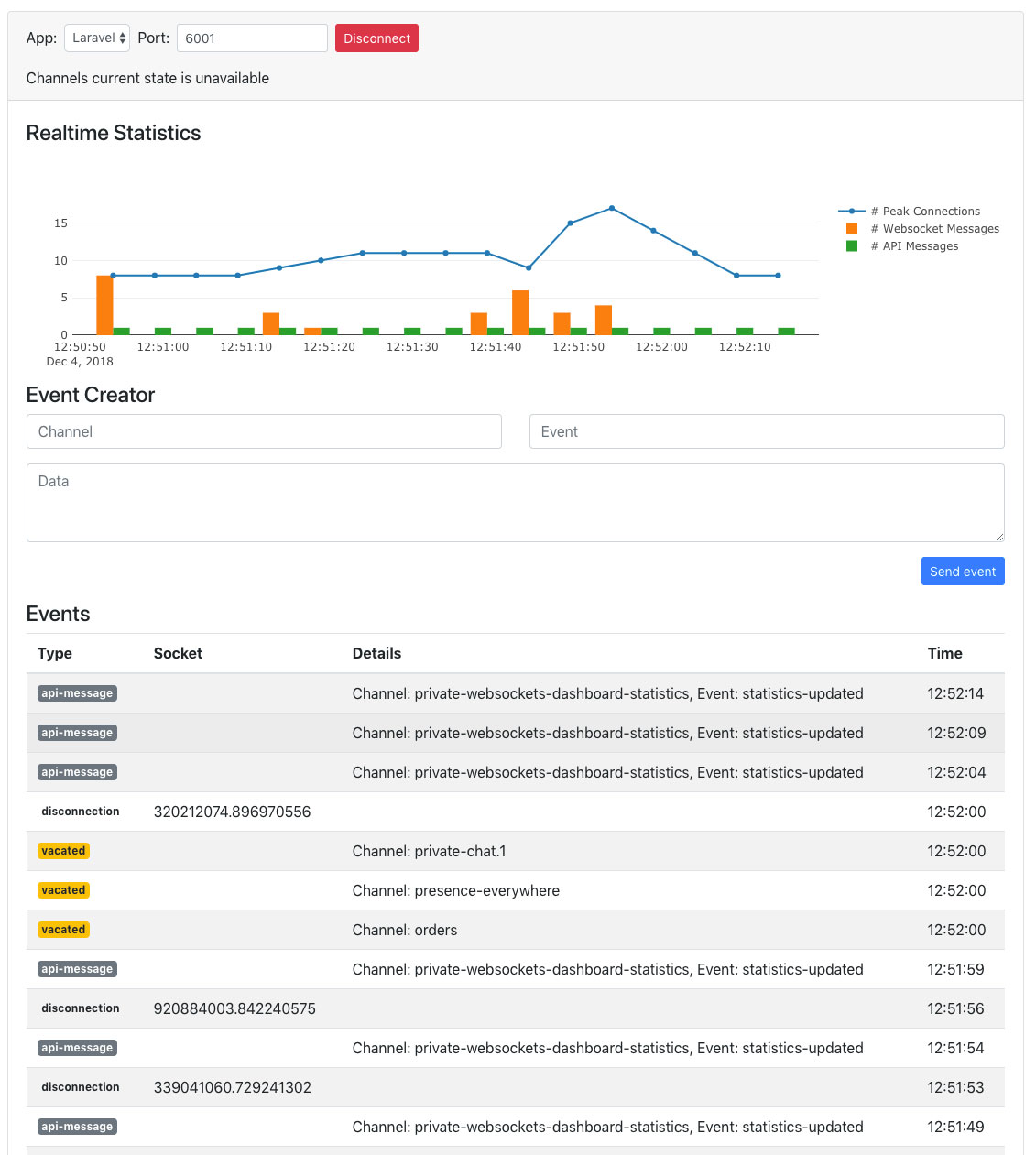
The package also comes with an excellent Debug Dashboard which can help you speed up development of WebSocket features in your applications:

Image credit: Official Debug Dashboard Documentation

The initial Laravel Websockets release is a collaborative effort by Marcel Pociot and Freek Van der Herten. Freek has a very detailed writeup Introducing laravel-websockets, an easy to use WebSocket server implemented in PHP that goes into great detail on the background of the package, how to use it, and many other aspects of the projects.

The documentation includes some benchmarks and the scale looks promising. Of course, your mileage will vary from project-to-project, including your specific application needs and usage patterns.

To learn more about the package and how to use it to check out the Laravel WebSockets documentation. The source code is available on GitHub at beyondcode/laravel-websockets.

Read More
  • Share This:  
  •  Facebook
  •  Twitter
  •  Google+
  •  Stumble
  •  Digg

Accountant Laravel Package

 Programing Coderfunda     April 23, 2021     Packages, php     No comments   


Accountant Laravel Package

Accountant is a Laravel accountably package for your Eloquent models by developer Quetzy Garcia. This package is a convenient way to keep track of Eloquent model changes:

Data discrepancies that may indicate business concerns suspect activities, and other actions that would otherwise pass unnoticed, can now be easily spotted.

At the time of writing, here are the key features according to the README:

  • Many-to-many (BelongsToMany and MorphToMany) relation support;
  • Event source style approach, by keeping complete snapshots of Recordable models when created, modified or retrieved;
  • Ability to recreate Recordable model instances in the exact state they were in when recorded;
  • Signed Ledger records for data integrity;
  • Effortless data integrity checks
  • Recording contexts
  • Huge customisation support
  • Easy to follow documentation and troubleshooting guide;
  • Laravel and Lumen 5.2+ support;

This package has a ton of features you can check it in the documentation. Here’s an example of the “Recordable” trait used to record model events:

<?php

namespace App\Models;

use Altek\Accountant\Contracts\Recordable;
use Illuminate\Database\Eloquent\Model;

class Article extends Model implements Recordable
{
use \Altek\Accountant\Recordable;

// ...
}


Accountant released v1.1.0 on January 1st, which introduced Many-to-many relationships, and forceDelete event support. You can even track pivot events – check the recordable model setup documentation for details on recording pivot events.

You can follow along with Accountant and view the source code on GitLab at Altek / Accountant, including the documentation which is available under version control in the same GitLab repository.

Read More
  • Share This:  
  •  Facebook
  •  Twitter
  •  Google+
  •  Stumble
  •  Digg
Newer Posts Older Posts Home

Meta

Popular Posts

  • Sitaare Zameen Par Full Movie Review
     Here’s a  complete Vue.js tutorial for beginners to master level , structured in a progressive and simple way. It covers all essential topi...
  • Tailwindcss best practices for responsive design
    Tailwind CSS provides powerful utilities for responsive design out of the box. To use it effectively and maintain clean, scalable code, here...
  • Crawl and Index Your Website with Laravel Site Search
      Laravel Site Search   is a package by Spatie to create a full-text search index by crawling your site. You can think of it as a private Go...
  • Tailwind CSS Tutorial (Beginner to Master)
    Here's a simple and complete Tailwind CSS tutorial designed for students and beginners , progressing step-by-step from beginner to mast...
  • Is there a way to write a JavaScript program that enables you to Search Words in Multiple PDF Files?
    I need to create a simple program/system/application using JavaScript that enables a user to search a certain word in multiple scanned PDF f...

Categories

  • Ajax (26)
  • Bootstrap (30)
  • DBMS (42)
  • HTML (12)
  • HTML5 (45)
  • JavaScript (10)
  • Jquery (34)
  • Jquery UI (2)
  • JqueryUI (32)
  • Laravel (1017)
  • Laravel Tutorials (23)
  • Laravel-Question (6)
  • Magento (9)
  • Magento 2 (95)
  • MariaDB (1)
  • MySql Tutorial (2)
  • PHP-Interview-Questions (3)
  • Php Question (13)
  • Python (36)
  • RDBMS (13)
  • SQL Tutorial (79)
  • Vue.js Tutorial (69)
  • Wordpress (150)
  • Wordpress Theme (3)
  • codeigniter (108)
  • oops (4)
  • php (853)

Social Media Links

  • Follow on Twitter
  • Like on Facebook
  • Subscribe on Youtube
  • Follow on Instagram

Pages

  • Home
  • Contact Us
  • Privacy Policy
  • About us

Blog Archive

  • July (4)
  • September (100)
  • August (50)
  • July (56)
  • June (46)
  • May (59)
  • April (50)
  • March (60)
  • February (42)
  • January (53)
  • December (58)
  • November (61)
  • October (39)
  • September (36)
  • August (36)
  • July (34)
  • June (34)
  • May (36)
  • April (29)
  • March (82)
  • February (1)
  • January (8)
  • December (14)
  • November (41)
  • October (13)
  • September (5)
  • August (48)
  • July (9)
  • June (6)
  • May (119)
  • April (259)
  • March (122)
  • February (368)
  • January (33)
  • October (2)
  • July (11)
  • June (29)
  • May (25)
  • April (168)
  • March (93)
  • February (60)
  • January (28)
  • December (195)
  • November (24)
  • October (40)
  • September (55)
  • August (6)
  • July (48)
  • May (2)
  • January (2)
  • July (6)
  • June (6)
  • February (17)
  • January (69)
  • December (122)
  • November (56)
  • October (92)
  • September (76)
  • August (6)

Loading...

Laravel News

Loading...

Copyright © CoderFunda | Powered by Blogger
Design by Coderfunda | Blogger Theme by Coderfunda | Distributed By Coderfunda