CoderFunda
  • Home
  • About us
    • Contact Us
    • Disclaimer
    • Privacy Policy
    • About us
  • Home
  • Php
  • HTML
  • CSS
  • JavaScript
    • JavaScript
    • Jquery
    • JqueryUI
    • Stock
  • SQL
  • Vue.Js
  • Python
  • Wordpress
  • C++
    • C++
    • C
  • Laravel
    • Laravel
      • Overview
      • Namespaces
      • Middleware
      • Routing
      • Configuration
      • Application Structure
      • Installation
    • Overview
  • DBMS
    • DBMS
      • PL/SQL
      • SQLite
      • MongoDB
      • Cassandra
      • MySQL
      • Oracle
      • CouchDB
      • Neo4j
      • DB2
      • Quiz
    • Overview
  • Entertainment
    • TV Series Update
    • Movie Review
    • Movie Review
  • More
    • Vue. Js
    • Php Question
    • Php Interview Question
    • Laravel Interview Question
    • SQL Interview Question
    • IAS Interview Question
    • PCS Interview Question
    • Technology
    • Other

04 April, 2022

DBMS Architecture

 Programing Coderfunda     April 04, 2022     DBMS     No comments   


DBMS Architecture

  • The DBMS design depends upon its architecture. The basic client/server architecture is used to deal with a large number of PCs, web servers, database servers, and other components that are connected with networks.
  • The client/server architecture consists of many PCs and a workstation that are connected via the network.
  • DBMS architecture depends upon how users are connected to the database to get their requests done.

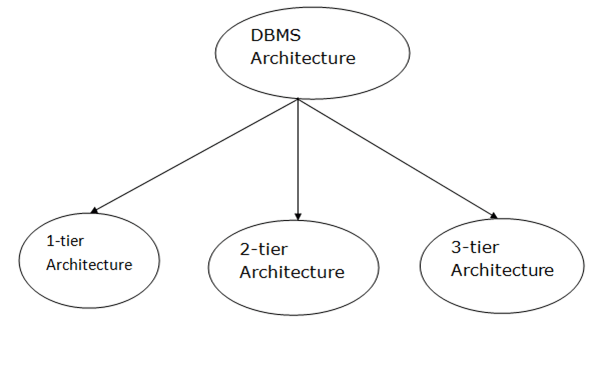
Types of DBMS Architecture

DBMS Architecture

Database architecture can be seen as a single-tier or multi-tier. But logically, database architecture is of two types: 2-tier architecture and 3-tier architecture.

1-Tier Architecture

  • In this architecture, the database is directly available to the user. It means the user can directly sit on the DBMS and uses it.
  • Any changes done here will directly be done on the database itself. It doesn't provide a handy tool for end-users.
  • The 1-Tier architecture is used for the development of the local application, where programmers can directly communicate with the database for a quick response.

2-Tier Architecture

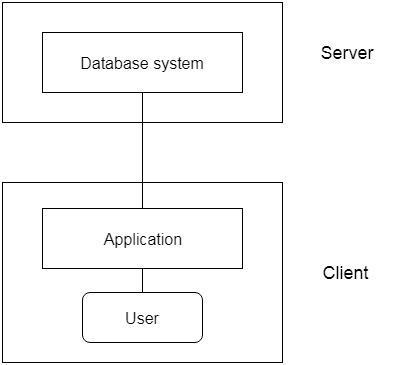
  • The 2-Tier architecture is the same as the basic client-server. In the two-tier architecture, applications on the client end can directly communicate with the database on the server-side. For this interaction, APIs like ODBC, and JDBC are used.
  • The user interfaces and application programs are run on the client-side.
  • The server side is responsible to provide the functionalities like query processing and transaction management.
  • To communicate with the DBMS, the client-side application establishes a connection with the server-side.
DBMS Architecture

Fig: 2-tier Architecture

3-Tier Architecture

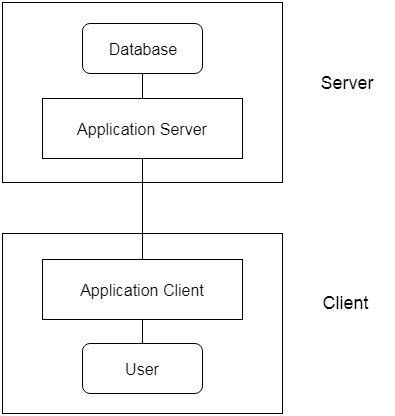
  • The 3-Tier architecture contains another layer between the client and server. In this architecture, the client can't directly communicate with the server.
  • The application on the client-end interacts with an application server which further communicates with the database system.
  • The end user has no idea about the existence of the database beyond the application server. The database also has no idea about any other user beyond the application.
  • The 3-Tier architecture is used in the case of the large web applications.
DBMS Architecture

Fig: 3-tier Architecture

  • Share This:  
  •  Facebook
  •  Twitter
  •  Google+
  •  Stumble
  •  Digg
Email ThisBlogThis!Share to XShare to Facebook
Newer Post Older Post Home

0 comments:

Post a Comment

Thanks

Meta

Popular Posts

  • Crawl and Index Your Website with Laravel Site Search
      Laravel Site Search   is a package by Spatie to create a full-text search index by crawling your site. You can think of it as a private Go...
  • JqueryUI - Show
    JqueryUI - Show, JqueryUI,  This chapter will discuss the show() method, which is one of the methods used to manage jQueryUI visual effe...
  • SpinLock VB.Net Example From MSDN Possibly Produces Incorrect Behaviour
    The code below is part of an example from MSDN. It is the example on how to use SpinLock but to my eye there is a race condition in it. Why ...
  • WordPress Table
    WordPress Table WordPress table is an easy way to show the data in the table format. In the past, we had used the HTML code or table plugin ...
  • Python exec() Function
    Python exec() Function The python  exec()  function is used for the dynamic execution of Python program which can either be a string or obje...

Categories

  • Ajax (26)
  • Bootstrap (30)
  • DBMS (42)
  • HTML (12)
  • HTML5 (45)
  • JavaScript (10)
  • Jquery (34)
  • Jquery UI (2)
  • JqueryUI (32)
  • Laravel (1017)
  • Laravel Tutorials (23)
  • Laravel-Question (6)
  • Magento (9)
  • Magento 2 (95)
  • MariaDB (1)
  • MySql Tutorial (2)
  • PHP-Interview-Questions (3)
  • Php Question (13)
  • Python (36)
  • RDBMS (13)
  • SQL Tutorial (79)
  • Vue.js Tutorial (69)
  • Wordpress (150)
  • Wordpress Theme (3)
  • codeigniter (108)
  • oops (4)
  • php (853)

Social Media Links

  • Follow on Twitter
  • Like on Facebook
  • Subscribe on Youtube
  • Follow on Instagram

Pages

  • Home
  • Contact Us
  • Privacy Policy
  • About us

Blog Archive

  • July (4)
  • September (100)
  • August (50)
  • July (56)
  • June (46)
  • May (59)
  • April (50)
  • March (60)
  • February (42)
  • January (53)
  • December (58)
  • November (61)
  • October (39)
  • September (36)
  • August (36)
  • July (34)
  • June (34)
  • May (36)
  • April (29)
  • March (82)
  • February (1)
  • January (8)
  • December (14)
  • November (41)
  • October (13)
  • September (5)
  • August (48)
  • July (9)
  • June (6)
  • May (119)
  • April (259)
  • March (122)
  • February (368)
  • January (33)
  • October (2)
  • July (11)
  • June (29)
  • May (25)
  • April (168)
  • March (93)
  • February (60)
  • January (28)
  • December (195)
  • November (24)
  • October (40)
  • September (55)
  • August (6)
  • July (48)
  • May (2)
  • January (2)
  • July (6)
  • June (6)
  • February (17)
  • January (69)
  • December (122)
  • November (56)
  • October (92)
  • September (76)
  • August (6)

Loading...

Laravel News

Loading...

Copyright © CoderFunda | Powered by Blogger
Design by Coderfunda | Blogger Theme by Coderfunda | Distributed By Coderfunda