CoderFunda
  • Home
  • About us
    • Contact Us
    • Disclaimer
    • Privacy Policy
    • About us
  • Home
  • Php
  • HTML
  • CSS
  • JavaScript
    • JavaScript
    • Jquery
    • JqueryUI
    • Stock
  • SQL
  • Vue.Js
  • Python
  • Wordpress
  • C++
    • C++
    • C
  • Laravel
    • Laravel
      • Overview
      • Namespaces
      • Middleware
      • Routing
      • Configuration
      • Application Structure
      • Installation
    • Overview
  • DBMS
    • DBMS
      • PL/SQL
      • SQLite
      • MongoDB
      • Cassandra
      • MySQL
      • Oracle
      • CouchDB
      • Neo4j
      • DB2
      • Quiz
    • Overview
  • Entertainment
    • TV Series Update
    • Movie Review
    • Movie Review
  • More
    • Vue. Js
    • Php Question
    • Php Interview Question
    • Laravel Interview Question
    • SQL Interview Question
    • IAS Interview Question
    • PCS Interview Question
    • Technology
    • Other
Showing posts with label CodeIgniter Benchmarking. Show all posts

11 December, 2018

CodeIgniter Benchmarking,CodeIgniter

 Programing Coderfunda     December 11, 2018     codeigniter, CodeIgniter Benchmarking     No comments   

Setting Benchmark Points

If you want to measure the time taken to execute a set of lines or memory usage, you can calculate it by using Benchmarking points in CodeIgniter. There is a separate “Benchmarking” class for this purpose in CodeIgniter.
This class is loaded automatically; you do not have to load it. It can be used anywhere in your controller, view, and model classes. All you have to do is to mark a start point and end point and then execute the elapsed_time()function between these two marked points and you can get the time it took to execute that code as shown below.
<?php 
$this
->benchmark->mark('code_start');

// Some code happens here

$this
->benchmark->mark('code_end');

echo $this
->benchmark->elapsed_time('code_start', 'code_end');
?>
To display the memory usage, use the function memory_usage() as shown in the following code.
<?php 
echo $this
->benchmark->memory_usage();
?>

Example

Create a controller called Profiler_controller.php and save it in application/controller/Profiler_controller.php
<?php 
class Profiler_controller extends CI_Controller {

public function index() {

//enable profiler
$this
->output->enable_profiler(TRUE);
$this
->load->view('test');
}

public function disable() {

//disable profiler
$this
->output->enable_profiler(FALSE);
$this
->load->view('test');
}

}
?>
Create a view file called test.php and save it at application/views/test.php
<!DOCTYPE html> 
<html lang = "en">

<head>
<meta charset = "utf-8">
<title>CodeIgniter View Example</title>
</head>

<body>
CodeIgniter View Example
</body>

</html>
Change the routes.php file at application/config/routes.php to add route for the above controller and add the following line at the end of the file.
$route['profiler'] = "Profiler_controller"; 
$route
['profiler/disable'] = "Profiler_controller/disable"
After that, you can type the following URL in the address bar of your browser to execute the example.
http://yoursite.com/index.php/profiler
The above URL will enable the profiler and it will produce an output as shown in the following screenshot.
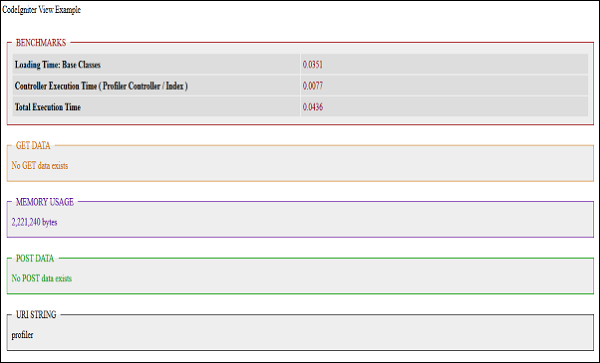
View Example
To disable the profiling, execute the following URL.
http://yoursite.com/index.php/profiler/disable

Read More
  • Share This:  
  •  Facebook
  •  Twitter
  •  Google+
  •  Stumble
  •  Digg

CodeIgniter Benchmarking,CodeIgniter

 Programing Coderfunda     December 11, 2018     codeigniter, CodeIgniter Benchmarking     No comments   

Setting Benchmark Points

If you want to measure the time taken to execute a set of lines or memory usage, you can calculate it by using Benchmarking points in CodeIgniter. There is a separate “Benchmarking” class for this purpose in CodeIgniter.
This class is loaded automatically; you do not have to load it. It can be used anywhere in your controller, view, and model classes. All you have to do is to mark a start point and end point and then execute the elapsed_time()function between these two marked points and you can get the time it took to execute that code as shown below.
<?php 
   $this->benchmark->mark('code_start');
  
   // Some code happens here  

   $this->benchmark->mark('code_end');
  
   echo $this->benchmark->elapsed_time('code_start', 'code_end'); 
?>
To display the memory usage, use the function memory_usage() as shown in the following code.
<?php 
   echo $this->benchmark->memory_usage(); 
?>

Example

Create a controller called Profiler_controller.php and save it in application/controller/Profiler_controller.php
<?php 
   class Profiler_controller extends CI_Controller {
  
      public function index() {
 
         //enable profiler
         $this->output->enable_profiler(TRUE); 
         $this->load->view('test'); 
      } 
  
      public function disable() {
 
         //disable profiler 
         $this->output->enable_profiler(FALSE); 
         $this->load->view('test'); 
      }
  
   } 
?>  
Create a view file called test.php and save it at application/views/test.php
<!DOCTYPE html> 
<html lang = "en">
 
   <head> 
      <meta charset = "utf-8"> 
      <title>CodeIgniter View Example</title> 
   </head>
 
   <body> 
      CodeIgniter View Example 
   </body>
 
</html>
Change the routes.php file at application/config/routes.php to add route for the above controller and add the following line at the end of the file.
$route['profiler'] = "Profiler_controller"; 
$route['profiler/disable'] = "Profiler_controller/disable"
After that, you can type the following URL in the address bar of your browser to execute the example.
http://yoursite.com/index.php/profiler
The above URL will enable the profiler and it will produce an output as shown in the following screenshot.
View Example
To disable the profiling, execute the following URL.
http://yoursite.com/index.php/profiler/disable

Read More
  • Share This:  
  •  Facebook
  •  Twitter
  •  Google+
  •  Stumble
  •  Digg
Older Posts Home

Meta

Popular Posts

  • Vue.js Events
      In Vue.js, Events are used to respond to an action. Suppose, you have to build a dynamic website using Vue.js then you'll most likely ...
  • Is there a way to use awk to count the number of rows between 2 flags and input that number into a specific field?
    I have a set of data that consists of seismic wave travel times and their corresponding information (i.e. source that produced the wave and ...
  • Use Leaflet.js and Google Maps Blade Components in Laravel
      Laravel Maps   is a package to easily create maps using   Leaflet.js   or Google Maps and Blade components. The main features that work wi...
  • Use Emmet-style Abbreviations in Blade Components
      Laravel   Blade Emerald   provides   Emmet -like abbreviations to generate and wrap Laravel Blade components with markup. It works by usin...
  • What is WordPress
      What is WordPress WordPress is a free and open-source  C ontent  M anagement  S ystem (CMS). It is an online site based on PHP and MySQL. ...

Categories

  • Ajax (26)
  • Bootstrap (30)
  • DBMS (42)
  • HTML (12)
  • HTML5 (45)
  • JavaScript (10)
  • Jquery (34)
  • Jquery UI (2)
  • JqueryUI (32)
  • Laravel (1017)
  • Laravel Tutorials (23)
  • Laravel-Question (6)
  • Magento (9)
  • Magento 2 (95)
  • MariaDB (1)
  • MySql Tutorial (2)
  • PHP-Interview-Questions (3)
  • Php Question (13)
  • Python (36)
  • RDBMS (13)
  • SQL Tutorial (79)
  • Vue.js Tutorial (69)
  • Wordpress (150)
  • Wordpress Theme (3)
  • codeigniter (108)
  • oops (4)
  • php (853)

Social Media Links

  • Follow on Twitter
  • Like on Facebook
  • Subscribe on Youtube
  • Follow on Instagram

Pages

  • Home
  • Contact Us
  • Privacy Policy
  • About us

Blog Archive

  • July (4)
  • September (100)
  • August (50)
  • July (56)
  • June (46)
  • May (59)
  • April (50)
  • March (60)
  • February (42)
  • January (53)
  • December (58)
  • November (61)
  • October (39)
  • September (36)
  • August (36)
  • July (34)
  • June (34)
  • May (36)
  • April (29)
  • March (82)
  • February (1)
  • January (8)
  • December (14)
  • November (41)
  • October (13)
  • September (5)
  • August (48)
  • July (9)
  • June (6)
  • May (119)
  • April (259)
  • March (122)
  • February (368)
  • January (33)
  • October (2)
  • July (11)
  • June (29)
  • May (25)
  • April (168)
  • March (93)
  • February (60)
  • January (28)
  • December (195)
  • November (24)
  • October (40)
  • September (55)
  • August (6)
  • July (48)
  • May (2)
  • January (2)
  • July (6)
  • June (6)
  • February (17)
  • January (69)
  • December (122)
  • November (56)
  • October (92)
  • September (76)
  • August (6)

Loading...

Laravel News

Loading...

Copyright © CoderFunda | Powered by Blogger
Design by Coderfunda | Blogger Theme by Coderfunda | Distributed By Coderfunda