CoderFunda
  • Home
  • About us
    • Contact Us
    • Disclaimer
    • Privacy Policy
    • About us
  • Home
  • Php
  • HTML
  • CSS
  • JavaScript
    • JavaScript
    • Jquery
    • JqueryUI
    • Stock
  • SQL
  • Vue.Js
  • Python
  • Wordpress
  • C++
    • C++
    • C
  • Laravel
    • Laravel
      • Overview
      • Namespaces
      • Middleware
      • Routing
      • Configuration
      • Application Structure
      • Installation
    • Overview
  • DBMS
    • DBMS
      • PL/SQL
      • SQLite
      • MongoDB
      • Cassandra
      • MySQL
      • Oracle
      • CouchDB
      • Neo4j
      • DB2
      • Quiz
    • Overview
  • Entertainment
    • TV Series Update
    • Movie Review
    • Movie Review
  • More
    • Vue. Js
    • Php Question
    • Php Interview Question
    • Laravel Interview Question
    • SQL Interview Question
    • IAS Interview Question
    • PCS Interview Question
    • Technology
    • Other

04 April, 2022

Types of Databases

 Programing Coderfunda     April 04, 2022     DBMS     No comments   


Types of Databases

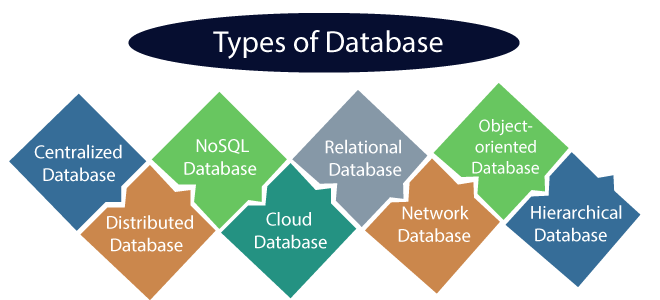
There are various types of databases used for storing different varieties of data:
Types of Databases

1) Centralized Database

It is the type of database that stores data at a centralized database system. It comforts the users to access the stored data from different locations through several applications. These applications contain the authentication process to let users access data securely. An example of a Centralized database can be Central Library that carries a central database of each library in a college/university.

Advantages of Centralized Database

  • It has decreased the risk of data management, i.e., manipulation of data will not affect the core data.
  • Data consistency is maintained as it manages data in a central repository.
  • It provides better data quality, which enables organizations to establish data standards.
  • It is less costly because fewer vendors are required to handle the data sets.

Disadvantages of Centralized Database

  • The size of the centralized database is large, which increases the response time for fetching the data.
  • It is not easy to update such an extensive database system.
  • If any server failure occurs, entire data will be lost, which could be a huge loss.

2) Distributed Database

Unlike a centralized database system, in distributed systems, data is distributed among different database systems of an organization. These database systems are connected via communication links. Such links help the end-users to access the data easily. Examples of the Distributed database are Apache Cassandra, HBase, Ignite, etc.

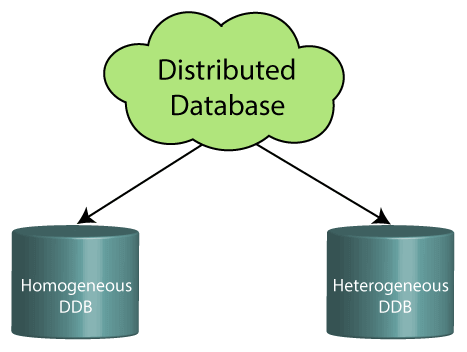
We can further divide a distributed database system into:
Types of Databases
  • Homogeneous DDB: Those database systems which execute on the same operating system and use the same application process and carry the same hardware devices.
  • Heterogeneous DDB: Those database systems which execute on different operating systems under different application procedures, and carries different hardware devices.

Advantages of Distributed Database

  • Modular development is possible in a distributed database, i.e., the system can be expanded by including new computers and connecting them to the distributed system.
  • One server failure will not affect the entire data set.

3) Relational Database

This database is based on the relational data model, which stores data in the form of rows(tuple) and columns(attributes), and together forms a table(relation). A relational database uses SQL for storing, manipulating, as well as maintaining the data. E.F. Codd invented the database in 1970. Each table in the database carries a key that makes the data unique from others. Examples of Relational databases are MySQL, Microsoft SQL Server, Oracle, etc.

Properties of Relational Database

There are following four commonly known properties of a relational model known as ACID properties, where:

A means Atomicity: This ensures the data operation will complete either with success or with failure. It follows the 'all or nothing' strategy. For example, a transaction will either be committed or will abort.

C means Consistency: If we perform any operation over the data, its value before and after the operation should be preserved. For example, the account balance before and after the transaction should be correct, i.e., it should remain conserved.

I means Isolation: There can be concurrent users for accessing data at the same time from the database. Thus, isolation between the data should remain isolated. For example, when multiple transactions occur at the same time, one transaction effects should not be visible to the other transactions in the database.

D means Durability: It ensures that once it completes the operation and commits the data, data changes should remain permanent.

4) NoSQL Database

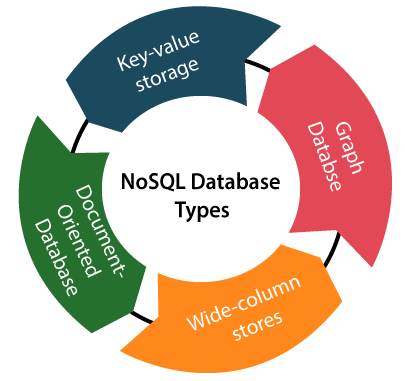
Non-SQL/Not Only SQL is a type of database that is used for storing a wide range of data sets. It is not a relational database as it stores data not only in tabular form but in several different ways. It came into existence when the demand for building modern applications increased. Thus, NoSQL presented a wide variety of database technologies in response to the demands. We can further divide a NoSQL database into the following four types:
Types of Databases
  1. Key-value storage: It is the simplest type of database storage where it stores every single item as a key (or attribute name) holding its value, together.
  2. Document-oriented Database: A type of database used to store data as JSON-like document. It helps developers in storing data by using the same document-model format as used in the application code.
  3. Graph Databases: It is used for storing vast amounts of data in a graph-like structure. Most commonly, social networking websites use the graph database.
  4. Wide-column stores: It is similar to the data represented in relational databases. Here, data is stored in large columns together, instead of storing in rows.

Advantages of NoSQL Database

  • It enables good productivity in the application development as it is not required to store data in a structured format.
  • It is a better option for managing and handling large data sets.
  • It provides high scalability.
  • Users can quickly access data from the database through key-value.

5) Cloud Database

A type of database where data is stored in a virtual environment and executes over the cloud computing platform. It provides users with various cloud computing services (SaaS, PaaS, IaaS, etc.) for accessing the database. There are numerous cloud platforms, but the best options are:

  • Amazon Web Services(AWS)
  • Microsoft Azure
  • Kamatera
  • PhonixNAP
  • ScienceSoft
  • Google Cloud SQL, etc.

6) Object-oriented Databases

The type of database that uses the object-based data model approach for storing data in the database system. The data is represented and stored as objects which are similar to the objects used in the object-oriented programming language.

7) Hierarchical Databases

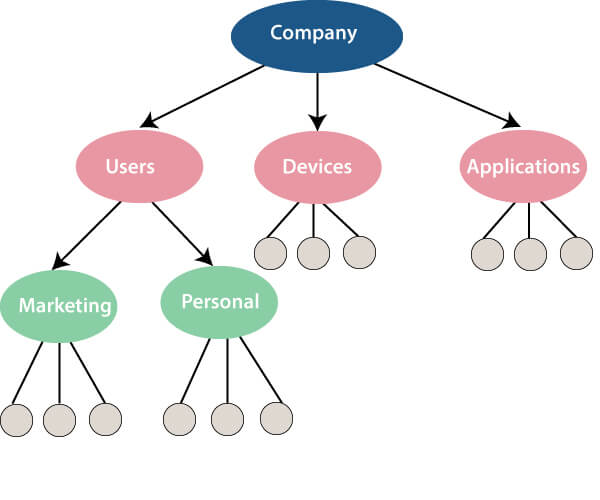
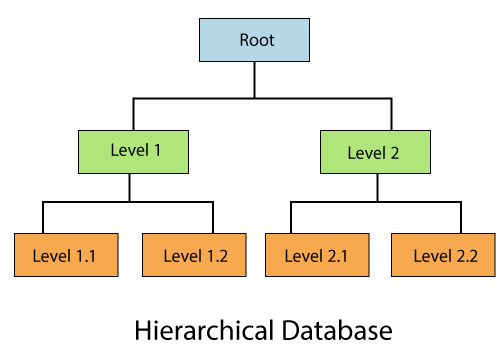
It is the type of database that stores data in the form of parent-children relationship nodes. Here, it organizes data in a tree-like structure.
Types of Databases

Data get stored in the form of records that are connected via links. Each child record in the tree will contain only one parent. On the other hand, each parent record can have multiple child records.

8) Network Databases

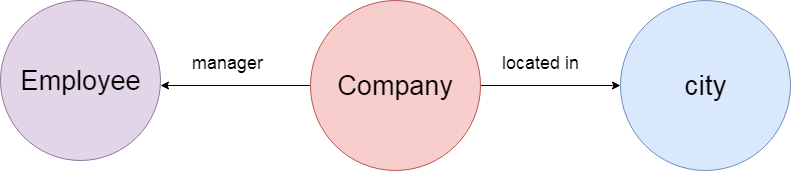
It is the database that typically follows the network data model. Here, the representation of data is in the form of nodes connected via links between them. Unlike the hierarchical database, it allows each record to have multiple children and parent nodes to form a generalized graph structure.

9) Personal Database

Collecting and storing data on the user's system defines a Personal Database. This database is basically designed for a single user.

Advantage of Personal Database

  • It is simple and easy to handle.
  • It occupies less storage space as it is small in size.

10) Operational Database

The type of database which creates and updates the database in real-time. It is basically designed for executing and handling the daily data operations in several businesses. For example, An organization uses operational databases for managing per day transactions.

11) Enterprise Database

Large organizations or enterprises use this database for managing a massive amount of data. It helps organizations to increase and improve their efficiency. Such a database allows simultaneous access to users.

Advantages of Enterprise Database:

  • Multi processes are supportable over the Enterprise database.
  • It allows executing parallel queries on the system.
Read More
  • Share This:  
  •  Facebook
  •  Twitter
  •  Google+
  •  Stumble
  •  Digg

What is database

 Programing Coderfunda     April 04, 2022     DBMS     No comments   


Database


What is Data?

Data is a collection of a distinct small unit of information. It can be used in a variety of forms like text, numbers, media, bytes, etc. it can be stored in pieces of paper or electronic memory, etc.

Word 'Data' is originated from the word 'datum' that means 'single piece of information.' It is plural of the word datum.

In computing, Data is information that can be translated into a form for efficient movement and processing. Data is interchangeable.

What is Database?

A database is an organized collection of data, so that it can be easily accessed and managed.

You can organize data into tables, rows, columns, and index it to make it easier to find relevant information.

Database handlers create a database in such a way that only one set of software program provides access of data to all the users.

The main purpose of the database is to operate a large amount of information by storing, retrieving, and managing data.

There are many dynamic websites on the World Wide Web nowadays which are handled through databases. For example, a model that checks the availability of rooms in a hotel. It is an example of a dynamic website that uses a database.

There are many databases available like MySQL, Sybase, Oracle, MongoDB, Informix, PostgreSQL, SQL Server, etc.

Modern databases are managed by the database management system (DBMS).

SQL or Structured Query Language is used to operate on the data stored in a database. SQL depends on relational algebra and tuple relational calculus.

A cylindrical structure is used to display the image of a database.

database

Evolution of Databases

The database has completed more than 50 years of journey of its evolution from flat-file system to relational and objects relational systems. It has gone through several generations.

The Evolution

File-Based

1968 was the year when File-Based database were introduced. In file-based databases, data was maintained in a flat file. Though files have many advantages, there are several limitations.

One of the major advantages is that the file system has various access methods, e.g., sequential, indexed, and random.

It requires extensive programming in a third-generation language such as COBOL, BASIC.

Hierarchical Data Model

1968-1980 was the era of the Hierarchical Database. Prominent hierarchical database model was IBM's first DBMS. It was called IMS (Information Management System).

In this model, files are related in a parent/child manner.

Below diagram represents Hierarchical Data Model. Small circle represents objects.

database 2

Like file system, this model also had some limitations like complex implementation, lack structural independence, can't easily handle a many-many relationship, etc.

Network data model

Charles Bachman developed the first DBMS at Honeywell called Integrated Data Store (IDS). It was developed in the early 1960s, but it was standardized in 1971 by the CODASYL group (Conference on Data Systems Languages).

In this model, files are related as owners and members, like to the common network model.

Network data model identified the following components:

  • Network schema (Database organization)
  • Sub-schema (views of database per user)
  • Data management language (procedural)

This model also had some limitations like system complexity and difficult to design and maintain.

Relational Database

1970 - Present: It is the era of Relational Database and Database Management. In 1970, the relational model was proposed by E.F. Codd.

Relational database model has two main terminologies called instance and schema.

The instance is a table with rows or columns

Schema specifies the structure like name of the relation, type of each column and name.

This model uses some mathematical concept like set theory and predicate logic.

The first internet database application had been created in 1995.

During the era of the relational database, many more models had introduced like object-oriented model, object-relational model, etc.

Cloud database

Cloud database facilitates you to store, manage, and retrieve their structured, unstructured data via a cloud platform. This data is accessible over the Internet. Cloud databases are also called a database as service (DBaaS) because they are offered as a managed service.

Some best cloud options are:

  • AWS (Amazon Web Services)
  • Snowflake Computing
  • Oracle Database Cloud Services
  • Microsoft SQL server
  • Google cloud spanner

Advantages of cloud database

Lower costs

Generally, company provider does not have to invest in databases. It can maintain and support one or more data centers.

Automated

Cloud databases are enriched with a variety of automated processes such as recovery, failover, and auto-scaling.

Increased accessibility

You can access your cloud-based database from any location, anytime. All you need is just an internet connection.

NoSQL Database

A NoSQL database is an approach to design such databases that can accommodate a wide variety of data models. NoSQL stands for "not only SQL." It is an alternative to traditional relational databases in which data is placed in tables, and data schema is perfectly designed before the database is built.

NoSQL databases are useful for a large set of distributed data.

Some examples of NoSQL database system with their category are:

  • MongoDB, CouchDB, Cloudant (Document-based)
  • Memcached, Redis, Coherence (key-value store)
  • HBase, Big Table, Accumulo (Tabular)

Advantage of NoSQL

High Scalability

NoSQL can handle an extensive amount of data because of scalability. If the data grows, NoSQL database scale it to handle that data in an efficient manner.

High Availability

NoSQL supports auto replication. Auto replication makes it highly available because, in case of any failure, data replicates itself to the previous consistent state.

Disadvantage of NoSQL

Open source

NoSQL is an open-source database, so there is no reliable standard for NoSQL yet.

Management challenge

Data management in NoSQL is much more complicated than relational databases. It is very challenging to install and even more hectic to manage daily.

GUI is not available

GUI tools for NoSQL database are not easily available in the market.

Backup

Backup is a great weak point for NoSQL databases. Some databases, like MongoDB, have no powerful approaches for data backup.

The Object-Oriented Databases

The object-oriented databases contain data in the form of object and classes. Objects are the real-world entity, and types are the collection of objects. An object-oriented database is a combination of relational model features with objects oriented principles. It is an alternative implementation to that of the relational model.

Object-oriented databases hold the rules of object-oriented programming. An object-oriented database management system is a hybrid application.

The object-oriented database model contains the following properties.

Object-oriented programming properties

  • Objects
  • Classes
  • Inheritance
  • Polymorphism
  • Encapsulation

Relational database properties

  • Atomicity
  • Consistency
  • Integrity
  • Durability
  • Concurrency
  • Query processing

Graph Databases

A graph database is a NoSQL database. It is a graphical representation of data. It contains nodes and edges. A node represents an entity, and each edge represents a relationship between two edges. Every node in a graph database represents a unique identifier.

Graph databases are beneficial for searching the relationship between data because they highlight the relationship between relevant data.

database 3

Graph databases are very useful when the database contains a complex relationship and dynamic schema.

It is mostly used in supply chain management, identifying the source of IP telephony.

DBMS (Data Base Management System)

Database management System is software which is used to store and retrieve the database. For example, Oracle, MySQL, etc.; these are some popular DBMS tools.

  • DBMS provides the interface to perform the various operations like creation, deletion, modification, etc.
  • DBMS allows the user to create their databases as per their requirement.
  • DBMS accepts the request from the application and provides specific data through the operating system.
  • DBMS contains the group of programs which acts according to the user instruction.
  • It provides security to the database.

Advantage of DBMS

Controls redundancy

It stores all the data in a single database file, so it can control data redundancy.

Data sharing

An authorized user can share the data among multiple users.

Backup

It providesBackup and recovery subsystem. This recovery system creates automatic data from system failure and restores data if required.

Multiple user interfaces

It provides a different type of user interfaces like GUI, application interfaces.

Disadvantage of DBMS

Size

It occupies large disk space and large memory to run efficiently.

Cost

DBMS requires a high-speed data processor and larger memory to run DBMS software, so it is costly.

Complexity

DBMS creates additional complexity and requirements.

RDBMS (Relational Database Management System)

The word RDBMS is termed as 'Relational Database Management System.' It is represented as a table that contains rows and column.

RDBMS is based on the Relational model; it was introduced by E. F. Codd.

A relational database contains the following components:

  • Table
  • Record/ Tuple
  • Field/Column name /Attribute
  • Instance
  • Schema
  • Keys

An RDBMS is a tabular DBMS that maintains the security, integrity, accuracy, and consistency of the data.


Read More
  • Share This:  
  •  Facebook
  •  Twitter
  •  Google+
  •  Stumble
  •  Digg

31 March, 2022

DBMS Tutorial

 Programing Coderfunda     March 31, 2022     DBMS     No comments   


DBMS Tutorial

DBMS Tutorial

DBMS Tutorial provides basic and advanced concepts of Database. Our DBMS Tutorial is designed for beginners and professionals both.

Database management system is software that is used to manage the database.

Our DBMS Tutorial includes all topics of DBMS such as introduction, ER model, keys, relational model, join operation, SQL, functional dependency, transaction, concurrency control, etc.

What is Database

The database is a collection of inter-related data which is used to retrieve, insert and delete the data efficiently. It is also used to organize the data in the form of a table, schema, views, and reports, etc.

For example: The college Database organizes the data about the admin, staff, students and faculty etc.

Using the database, you can easily retrieve, insert, and delete the information.

Database Management System

  • Database management system is a software which is used to manage the database. For example: MySQL, Oracle, etc are a very popular commercial database which is used in different applications.
  • DBMS provides an interface to perform various operations like database creation, storing data in it, updating data, creating a table in the database and a lot more.
  • It provides protection and security to the database. In the case of multiple users, it also maintains data consistency.

DBMS allows users the following tasks:

  • Data Definition: It is used for creation, modification, and removal of definition that defines the organization of data in the database.
  • Data Updation: It is used for the insertion, modification, and deletion of the actual data in the database.
  • Data Retrieval: It is used to retrieve the data from the database which can be used by applications for various purposes.
  • User Administration: It is used for registering and monitoring users, maintain data integrity, enforcing data security, dealing with concurrency control, monitoring performance and recovering information corrupted by unexpected failure.

Characteristics of DBMS

  • It uses a digital repository established on a server to store and manage the information.
  • It can provide a clear and logical view of the process that manipulates data.
  • DBMS contains automatic backup and recovery procedures.
  • It contains ACID properties which maintain data in a healthy state in case of failure.
  • It can reduce the complex relationship between data.
  • It is used to support manipulation and processing of data.
  • It is used to provide security of data.
  • It can view the database from different viewpoints according to the requirements of the user.

Advantages of DBMS

  • Controls database redundancy: It can control data redundancy because it stores all the data in one single database file and that recorded data is placed in the database.
  • Data sharing: In DBMS, the authorized users of an organization can share the data among multiple users.
  • Easily Maintenance: It can be easily maintainable due to the centralized nature of the database system.
  • Reduce time: It reduces development time and maintenance need.
  • Backup: It provides backup and recovery subsystems which create automatic backup of data from hardware and software failures and restores the data if required.
  • multiple user interface: It provides different types of user interfaces like graphical user interfaces, application program interfaces

Disadvantages of DBMS

  • Cost of Hardware and Software: It requires a high speed of data processor and large memory size to run DBMS software.
  • Size: It occupies a large space of disks and large memory to run them efficiently.
  • Complexity: Database system creates additional complexity and requirements.
  • Higher impact of failure: Failure is highly impacted the database because in most of the organization, all the data stored in a single database and if the database is damaged due to electric failure or database corruption then the data may be lost forever.

DBMS Index


DBMS Tutorial

  • DBMS Tutorial
  • DBMS vs File System
  • DBMS Architecture
  • Three schema Architecture
  • Data model schema
  • Data Independence
  • DBMS Language

Data modeling

  • ER model concept
  • Notation for ER diagram
  • Mapping constraints
  • DBMS Keys
  • DBMS Generalization
  • DBMS Specialization
  • DBMS Aggregation
  • Convert ER into table
  • Relationship of Higher Degree

Relational data Model

  • Relational Model concept
  • Relational Algebra
  • Join Operation
  • Integrity Constraints
  • Relational Calculus

Normalization

  • Functional Dependency
  • Inference Rule
  • DBMS Normalization
  • DBMS 1NF
  • DBMS 2NF
  • DBMS 3NF
  • DBMS BCNF
  • DBMS 4NF
  • DBMS 5NF
  • Relational Decomposition
  • Multivalued Dependency
  • Join Dependency
  • Inclusion Dependence

Transaction Processing

  • Transaction
  • Transaction Property
  • States of Transaction
  • DBMS Schedule
  • Testing of Serializability
  • Conflict schedule
  • View Serializability
  • Recoverability of Schedule
  • Failure Classification
  • Log-Based Recovery
  • DBMS Checkpoint
  • Deadlock in DBMS

Concurrency Control

  • Concurrency Control
  • Lock based Protocol
  • Time stamping Protocol
  • Validation based Protocol
  • Thomas Write Rule
  • Multiple Granularity
  • Recovery Concurrent Transaction

File organization

  • File organization
  • Sequential File Organization
  • Heap File Organization
  • Hash File Organization
  • B+ File Organization
  • DBMS ISAM
  • Cluster File Organization

Indexing and B+ Tree

  • Indexing in DBMS
  • B+ Tree

Hashing

  • Hashing
  • Static Hashing
  • Dynamic Hashing

RAID

  • RAID

SQL Introduction

  • SQL Introduction
  • Characteristics of SQL
  • Advantage of SQL
  • SQl Datatype
  • SQL Command
  • SQL Operator
  • SQL Table
  • SQL SELECT Statement
  • SQL INSERT Statement
  • SQL Update Statement
  • SQL DELETE Statement
  • SQL View
  • SQL Index
  • SQL Sub Queries
  • SQL Clauses
  • SQL Aggregate Function
  • SQL JOIN
  • SQL Set Operation

Interview Questions

  • DBMS Interview Questions
  • SQL Interview Questions

Prerequisite

Before learning DBMS Tutorial, you must have the basic knowledge of Basic Database.

Audience

Our DBMS Tutorial is designed to help beginners and professionals.

Problem

We assure that you will not find any problem with this DBMS Tutorial. But if there is any mistake, please post the problem in the contact form.

Read More
  • Share This:  
  •  Facebook
  •  Twitter
  •  Google+
  •  Stumble
  •  Digg
Newer Posts Older Posts Home

Meta

Popular Posts

  • Generate Migrations from an Existing Database With the Migration Generator Package
    Laravel Migration Generator Migration Generator for Laravel is a package by Bennett Treptow to generate migrations from existing database ...
  • Search Through Models with Laravel Searchable
      Laravel Searchable   is a package by   Spatie   to search through models and other sources pragmatically. Using this package, you can get ...
  • Laravel Razorpay Integration | Payment gateway integration Laravel in 30 mins | Laravel Razorpay
    1 Integration of Razorpay with Laravel. In this tutorial, I have taught how to integrate payment gateway with laravel with mini-project. If...
  • .Net 8 XUnit: Use an In-Memory DBConnection for testing as a replacement for the real MySqlConnection
    I'm creating tests for my .Net 8 API, and as I want to test with fake self created data (instead of using the real MySql connection) I...
  • Vue.js Render functions
        Vue.js Render functions Vue.js recommends us to use templates to build HTML. Here, we can use the render function as a closer-to-the-co...

Categories

  • Ajax (26)
  • Bootstrap (30)
  • DBMS (42)
  • HTML (12)
  • HTML5 (45)
  • JavaScript (10)
  • Jquery (34)
  • Jquery UI (2)
  • JqueryUI (32)
  • Laravel (1017)
  • Laravel Tutorials (23)
  • Laravel-Question (6)
  • Magento (9)
  • Magento 2 (95)
  • MariaDB (1)
  • MySql Tutorial (2)
  • PHP-Interview-Questions (3)
  • Php Question (13)
  • Python (36)
  • RDBMS (13)
  • SQL Tutorial (79)
  • Vue.js Tutorial (69)
  • Wordpress (150)
  • Wordpress Theme (3)
  • codeigniter (108)
  • oops (4)
  • php (853)

Social Media Links

  • Follow on Twitter
  • Like on Facebook
  • Subscribe on Youtube
  • Follow on Instagram

Pages

  • Home
  • Contact Us
  • Privacy Policy
  • About us

Blog Archive

  • ▼  2026 (12)
    • ▼  07/26 - 08/02 (11)
      • 'The Odyssey' crosses USD 639.6 million globally
      • 'Ramayana' to have 'Baahubali'-style cliffhanger e...
      • Kim Kardashian remember late granny on 92nd heaven...
      • Emma Roberts weds Cody John in intimate Idaho cere...
      • 'Jana Nayagan' BO day 4: Film crosses Rs 100 Cr Net
      • 'Chennai Love Story' BO jumps 11.1%
      • China’s new hybrid rice can preserve its high-yiel...
      • Quote of the day by Thucydides: 'Self-control is t...
      • Quote of the day by Slavoj Žižek: 'The problem for...
      • A stormwater pond in Calgary appears filled with P...
      • Inside Kriti Sanon's duplex sea-facing penthouse w...
    • ►  06/28 - 07/05 (1)
  • ►  2025 (4)
    • ►  07/06 - 07/13 (2)
    • ►  06/29 - 07/06 (2)
  • ►  2024 (486)
    • ►  09/15 - 09/22 (30)
    • ►  09/08 - 09/15 (35)
    • ►  09/01 - 09/08 (35)
    • ►  08/11 - 08/18 (2)
    • ►  08/04 - 08/11 (33)
    • ►  07/28 - 08/04 (30)
    • ►  07/07 - 07/14 (11)
    • ►  06/30 - 07/07 (35)
    • ►  06/23 - 06/30 (5)
    • ►  06/02 - 06/09 (31)
    • ►  05/26 - 06/02 (20)
    • ►  05/05 - 05/12 (29)
    • ►  04/28 - 05/05 (26)
    • ►  04/07 - 04/14 (10)
    • ►  03/31 - 04/07 (34)
    • ►  03/24 - 03/31 (10)
    • ►  03/03 - 03/10 (35)
    • ►  02/25 - 03/03 (15)
    • ►  02/04 - 02/11 (22)
    • ►  01/28 - 02/04 (30)
    • ►  01/07 - 01/14 (8)
  • ►  2023 (484)
    • ►  12/31 - 01/07 (35)
    • ►  12/24 - 12/31 (10)
    • ►  12/03 - 12/10 (33)
    • ►  11/26 - 12/03 (20)
    • ►  11/05 - 11/12 (35)
    • ►  10/29 - 11/05 (20)
    • ►  10/22 - 10/29 (9)
    • ►  10/15 - 10/22 (7)
    • ►  10/08 - 10/15 (9)
    • ►  10/01 - 10/08 (10)
    • ►  09/24 - 10/01 (9)
    • ►  09/17 - 09/24 (9)
    • ►  09/10 - 09/17 (7)
    • ►  09/03 - 09/10 (9)
    • ►  08/27 - 09/03 (9)
    • ►  08/20 - 08/27 (8)
    • ►  08/13 - 08/20 (8)
    • ►  08/06 - 08/13 (8)
    • ►  07/30 - 08/06 (8)
    • ►  07/23 - 07/30 (7)
    • ►  07/16 - 07/23 (8)
    • ►  07/09 - 07/16 (7)
    • ►  07/02 - 07/09 (8)
    • ►  06/25 - 07/02 (7)
    • ►  06/18 - 06/25 (7)
    • ►  06/11 - 06/18 (7)
    • ►  06/04 - 06/11 (11)
    • ►  05/28 - 06/04 (7)
    • ►  05/21 - 05/28 (8)
    • ►  05/14 - 05/21 (11)
    • ►  05/07 - 05/14 (7)
    • ►  04/30 - 05/07 (7)
    • ►  04/23 - 04/30 (8)
    • ►  04/16 - 04/23 (9)
    • ►  04/09 - 04/16 (7)
    • ►  04/02 - 04/09 (4)
    • ►  03/26 - 04/02 (21)
    • ►  03/19 - 03/26 (2)
    • ►  03/12 - 03/19 (9)
    • ►  03/05 - 03/12 (26)
    • ►  02/26 - 03/05 (25)
    • ►  01/15 - 01/22 (7)
    • ►  01/08 - 01/15 (1)
  • ►  2022 (1037)
    • ►  12/11 - 12/18 (13)
    • ►  12/04 - 12/11 (1)
    • ►  11/27 - 12/04 (40)
    • ►  11/06 - 11/13 (1)
    • ►  10/16 - 10/23 (13)
    • ►  09/04 - 09/11 (5)
    • ►  08/21 - 08/28 (24)
    • ►  08/14 - 08/21 (24)
    • ►  07/03 - 07/10 (9)
    • ►  06/19 - 06/26 (3)
    • ►  05/29 - 06/05 (3)
    • ►  05/22 - 05/29 (3)
    • ►  05/15 - 05/22 (109)
    • ►  05/01 - 05/08 (7)
    • ►  04/24 - 05/01 (7)
    • ►  04/17 - 04/24 (64)
    • ►  04/10 - 04/17 (115)
    • ►  04/03 - 04/10 (73)
    • ►  03/27 - 04/03 (77)
    • ►  03/13 - 03/20 (2)
    • ►  03/06 - 03/13 (25)
    • ►  02/27 - 03/06 (18)
    • ►  02/20 - 02/27 (153)
    • ►  02/13 - 02/20 (187)
    • ►  01/30 - 02/06 (45)
    • ►  01/23 - 01/30 (15)
    • ►  01/16 - 01/23 (1)
  • ►  2021 (412)
    • ►  10/24 - 10/31 (2)
    • ►  07/25 - 08/01 (1)
    • ►  07/11 - 07/18 (10)
    • ►  06/13 - 06/20 (29)
    • ►  05/23 - 05/30 (1)
    • ►  05/02 - 05/09 (24)
    • ►  04/25 - 05/02 (24)
    • ►  04/18 - 04/25 (112)
    • ►  04/11 - 04/18 (1)
    • ►  04/04 - 04/11 (6)
    • ►  03/28 - 04/04 (86)
    • ►  03/21 - 03/28 (19)
    • ►  03/14 - 03/21 (2)
    • ►  03/07 - 03/14 (10)
    • ►  02/28 - 03/07 (1)
    • ►  02/21 - 02/28 (29)
    • ►  02/14 - 02/21 (13)
    • ►  02/07 - 02/14 (12)
    • ►  01/31 - 02/07 (6)
    • ►  01/17 - 01/24 (2)
    • ►  01/10 - 01/17 (8)
    • ►  01/03 - 01/10 (14)
  • ►  2020 (376)
    • ►  12/27 - 01/03 (37)
    • ►  12/20 - 12/27 (92)
    • ►  12/13 - 12/20 (29)
    • ►  12/06 - 12/13 (37)
    • ►  11/29 - 12/06 (4)
    • ►  11/15 - 11/22 (14)
    • ►  11/08 - 11/15 (8)
    • ►  11/01 - 11/08 (2)
    • ►  10/18 - 10/25 (14)
    • ►  10/11 - 10/18 (16)
    • ►  10/04 - 10/11 (10)
    • ►  09/20 - 09/27 (10)
    • ►  09/06 - 09/13 (19)
    • ►  08/30 - 09/06 (26)
    • ►  08/23 - 08/30 (4)
    • ►  08/16 - 08/23 (2)
    • ►  07/12 - 07/19 (48)
    • ►  05/17 - 05/24 (2)
    • ►  01/05 - 01/12 (2)
  • ►  2019 (74)
    • ►  07/07 - 07/14 (6)
    • ►  06/16 - 06/23 (6)
    • ►  02/10 - 02/17 (17)
    • ►  01/13 - 01/20 (37)
    • ►  01/06 - 01/13 (8)
  • ►  2018 (376)
    • ►  12/30 - 01/06 (24)
    • ►  12/16 - 12/23 (8)
    • ►  12/09 - 12/16 (98)
    • ►  12/02 - 12/09 (16)
    • ►  11/18 - 11/25 (36)
    • ►  11/04 - 11/11 (18)
    • ►  10/28 - 11/04 (10)
    • ►  10/21 - 10/28 (26)
    • ►  10/14 - 10/21 (52)
    • ►  10/07 - 10/14 (4)
    • ►  09/30 - 10/07 (2)
    • ►  09/23 - 09/30 (68)
    • ►  09/16 - 09/23 (4)
    • ►  09/09 - 09/16 (4)
    • ►  08/26 - 09/02 (6)

Data Publish News

Loading...

Al Jazeera – Breaking News, World News and Video from Al Jazeera

Loading...

Laravel News

Loading...

Copyright © CoderFunda | Powered by Blogger
Design by Coderfunda | Blogger Theme by Coderfunda | Distributed By Coderfunda