CoderFunda
  • Home
  • About us
    • Contact Us
    • Disclaimer
    • Privacy Policy
    • About us
  • Home
  • Php
  • HTML
  • CSS
  • JavaScript
    • JavaScript
    • Jquery
    • JqueryUI
    • Stock
  • SQL
  • Vue.Js
  • Python
  • Wordpress
  • C++
    • C++
    • C
  • Laravel
    • Laravel
      • Overview
      • Namespaces
      • Middleware
      • Routing
      • Configuration
      • Application Structure
      • Installation
    • Overview
  • DBMS
    • DBMS
      • PL/SQL
      • SQLite
      • MongoDB
      • Cassandra
      • MySQL
      • Oracle
      • CouchDB
      • Neo4j
      • DB2
      • Quiz
    • Overview
  • Entertainment
    • TV Series Update
    • Movie Review
    • Movie Review
  • More
    • Vue. Js
    • Php Question
    • Php Interview Question
    • Laravel Interview Question
    • SQL Interview Question
    • IAS Interview Question
    • PCS Interview Question
    • Technology
    • Other

05 April, 2022

Join Operations

 Programing Coderfunda     April 05, 2022     DBMS     No comments   

 Joint Operations:

A join operation combines related tuples from different relations, if and only if a given join condition is satisfied. It is denoted by ⋈.

Example:

EMPLOYEE

EMP_CODEEMP_NAME
101Stephan
102Jack
103Harry

SALARY

EMP_CODESALARY
10150000
10230000
10325000
  1. Operation: (EMPLOYEE ⋈ SALARY)   

Result:

EMP_CODEEMP_NAMESALARY
101Stephan50000
102Jack30000
103Harry25000

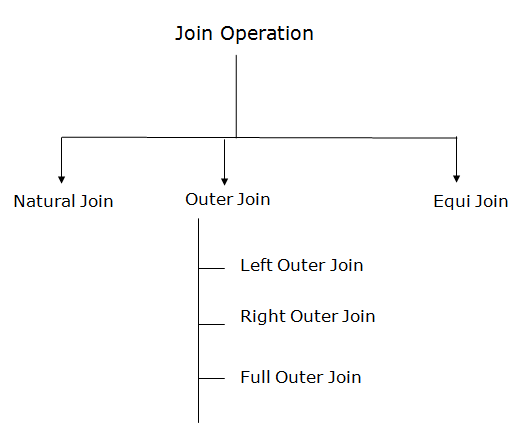
Types of Join operations:


DBMS Join Operation

1. Natural Join:

  • A natural join is the set of tuples of all combinations in R and S that are equal on their common attribute names.
  • It is denoted by ⋈.

Example: Let's use the above EMPLOYEE table and SALARY table:

Input:

  1. ∏EMP_NAME, SALARY (EMPLOYEE ⋈ SALARY)  

Output:

EMP_NAMESALARY
Stephan50000
Jack30000
Harry25000

2. Outer Join:

The outer join operation is an extension of the join operation. It is used to deal with missing information.

Example:

EMPLOYEE

EMP_NAMESTREETCITY
RamCivil lineMumbai
ShyamPark streetKolkata
RaviM.G. StreetDelhi
HariNehru Nagar HyderabadHyderabadHyderabad Hyderabad

FACT_WORKERS

EMP_NAMEBRANCHSALARY
RamInfosys10000
ShyamWipro20000
KuberHCL30000
HariTCS50000

Input:

  1. (EMPLOYEE ⋈ FACT_WORKERS)  

Output:

EMP_NAMESTREETCITYBRANCHSALARY
RamCivil lineMumbaiInfosys10000
ShyamPark streetKolkataWipro20000
HariNehru nagarHyderabadTCS50000

An outer join is basically of three types:

  1. Left outer join
  2. Right outer join
  3. Full outer join

a. Left outer join:

  • Left outer join contains the set of tuples of all combinations in R and S that are equal on their common attribute names.
  • In the left outer join, tuples in R have no matching tuples in S.
  • It is denoted by ⟕.

Example: Using the above EMPLOYEE table and FACT_WORKERS table

Input:

  1. EMPLOYEE ⟕ FACT_WORKERS   

EMP_NAMESTREETCITYBRANCHSALARY
RamCivil lineMumbaiInfosys10000
ShyamPark streetKolkataWipro20000
HariNehru streetHyderabadTCS50000
RaviM.G. StreetDelhiNULLNULL

b. Right outer join:

  • Right outer join contains the set of tuples of all combinations in R and S that are equal on their common attribute names.
  • In the right outer join, tuples in S have no matching tuples in R.
  • It is denoted by ⟖.

Example: Using the above EMPLOYEE table and FACT_WORKERS Relation

Input:

  1. EMPLOYEE ⟖ FACT_WORKERS  

Output:

EMP_NAMEBRANCHSALARYSTREETCITY
RamInfosys10000Civil lineMumbai
ShyamWipro20000Park streetKolkata
HariTCS50000Nehru streetHyderabad
KuberHCL30000NULLNULL

c. Full outer join:

  • A full outer join is like a left or right join except that it contains all rows from both tables.
  • In full outer join, tuples in R have no matching tuples in S, and tuples in S have no matching tuples in R in their common attribute name.
  • It is denoted by ⟗.

Example: Using the above EMPLOYEE table and FACT_WORKERS table

Input:

  1. EMPLOYEE ⟗ FACT_WORKERS  

Output:

EMP_NAMESTREETCITYBRANCHSALARY
RamCivil lineMumbaiInfosys10000
ShyamPark streetKolkataWipro20000
HariNehru streetHyderabadTCS50000
RaviM.G. StreetDelhiNULLNULL
KuberNULLNULLHCL30000

3. Equi join:

It is also known as an inner join. It is the most common join. It is based on matched data as per the equality condition. The equi join uses the comparison operator(=).

Example:

CUSTOMER RELATION

CLASS_IDNAME
1John
2Harry
3Jackson

PRODUCT

PRODUCT_IDCITY
1Delhi
2Mumbai
3Noida

Input:

  1. CUSTOMER ⋈ PRODUCT    

Output:

CLASS_IDNAMEPRODUCT_IDCITY
1John1Delhi
2Harry2Mumbai
3Harry3Noida

Read More
  • Share This:  
  •  Facebook
  •  Twitter
  •  Google+
  •  Stumble
  •  Digg

Relational Algebra

 Programing Coderfunda     April 05, 2022     DBMS     No comments   

Relational Algebra

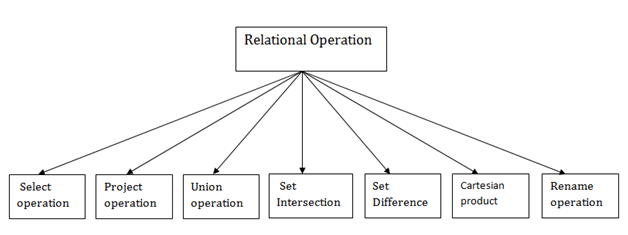
Relational algebra is a procedural query language. It gives a step-by-step process to obtain the result of the query. It uses operators to perform queries.

Types of Relational operation


DBMS Relational Algebra

1. Select Operation:

  • The select operation selects tuples that satisfy a given predicate.
  • It is denoted by sigma (σ).
  1. Notation:  σ p(r)  

Where:

σ is used for selection prediction
r is used for relation
p is used as a propositional logic formula which may use connectors like: AND OR and NOT. These relational can use as relational operators like =, ≠, ≥, <, >, ≤.

For example LOAN Relation

BRANCH_NAMELOAN_NOAMOUNT
DowntownL-171000
RedwoodL-232000
PerryrideL-151500
DowntownL-141500
MianusL-13500
RoundhillL-11900
PerryrideL-161300

Input:

  1. σ BRANCH_NAME="ferry ride" (LOAN)  

Output:

BRANCH_NAMELOAN_NOAMOUNT
PerryrideL-151500
PerryrideL-161300

2. Project Operation:

  • This operation shows the list of those attributes that we wish to appear in the result. The rest of the attributes are eliminated from the table.
  • It is denoted by ∏.
  1. Notation: ∏ A1, A2, An (r)   

Where

A1, A2, A3 are used as an attribute name of relation r.

Example: CUSTOMER RELATION

NAMESTREETCITY
JonesMainHarrison
SmithNorthRye
HaysMainHarrison
CurryNorthRye
JohnsonAlmaBrooklyn
BrooksSenatorBrooklyn

Input:

  1. ∏ NAME, CITY (CUSTOMER)  

Output:

NAMECITY
JonesHarrison
SmithRye
HaysHarrison
CurryRye
JohnsonBrooklyn
BrooksBrooklyn

3. Union Operation:

  • Suppose there are two tuples R and S. The union operation contains all the tuples that are either in R or S or both in R & S.
  • It eliminates the duplicate tuples. It is denoted by ∪.
  1. Notation: R ∪ S   

A union operation must hold the following condition:

  • R and S must have the attribute of the same number.
  • Duplicate tuples are eliminated automatically.

Example:

DEPOSITOR RELATION

CUSTOMER_NAMEACCOUNT_NO
JohnsonA-101
SmithA-121
MayesA-321
TurnerA-176
JohnsonA-273
JonesA-472
LindsayA-284

BORROW RELATION

CUSTOMER_NAMELOAN_NO
JonesL-17
SmithL-23
HayesL-15
JacksonL-14
CurryL-93
SmithL-11
WilliamsL-17

Input:

  1. ∏ CUSTOMER_NAME (BORROW) ∪ ∏ CUSTOMER_NAME (DEPOSITOR)  

Output:

CUSTOMER_NAME
Johnson
Smith
Hayes
Turner
Jones
Lindsay
Jackson
Curry
Williams
Mayes

4. Set Intersection:

  • Suppose there are two tuples R and S. The set intersection operation contains all tuples that are in both R & S.
  • It is denoted by intersection ∩.
  1. Notation: R ∩ S   

Example: Using the above DEPOSITOR table and BORROW table

Input:

  1. ∏ CUSTOMER_NAME (BORROW) ∩ ∏ CUSTOMER_NAME (DEPOSITOR)  

Output:

CUSTOMER_NAME
Smith
Jones

5. Set Difference:

  • Suppose there are two tuples R and S. The set intersection operation contains all tuples that are in R but not in S.
  • It is denoted by intersection minus (-).
  1. Notation: R - S  

Example: Using the above DEPOSITOR table and BORROW table

Input:

  1. ∏ CUSTOMER_NAME (BORROW) - ∏ CUSTOMER_NAME (DEPOSITOR)  

Output:

CUSTOMER_NAME
Jackson
Hayes
Willians
Curry

6. Cartesian product

  • The Cartesian product is used to combine each row in one table with each row in the other table. It is also known as a cross-product.
  • It is denoted by X.
  1. Notation: E X D  

Example:

EMPLOYEE

EMP_IDEMP_NAMEEMP_DEPT
1SmithA
2HarryC
3JohnB

DEPARTMENT

DEPT_NODEPT_NAME
AMarketing
BSales
CLegal

Input:

  1. EMPLOYEE X DEPARTMENT  

Output:

EMP_IDEMP_NAMEEMP_DEPTDEPT_NODEPT_NAME
1SmithAAMarketing
1SmithABSales
1SmithACLegal
2HarryCAMarketing
2HarryCBSales
2HarryCCLegal
3JohnBAMarketing
3JohnBBSales
3JohnBCLegal

7. Rename Operation:

The rename operation is used to rename the output relation. It is denoted by rho (ρ).

Example: We can use the rename operator to rename STUDENT relation to STUDENT1.

  1. ρ(STUDENT1, STUDENT)  
Read More
  • Share This:  
  •  Facebook
  •  Twitter
  •  Google+
  •  Stumble
  •  Digg

04 April, 2022

Relational Model concept

 Programing Coderfunda     April 04, 2022     DBMS     No comments   


Relational Model concept

The relational model can represent as a table with columns and rows. Each row is known as a tuple. Each table of the column has a name or attribute.

Domain: It contains a set of atomic values that an attribute can take.

Attribute: It contains the name of a column in a particular table. Each attribute Ai must have a domain, dom(Ai)

Relational instance: In the relational database system, the relational instance is represented by a finite set of tuples. Relation instances do not have duplicate tuples.

Relational schema: A relational schema contains the name of the relation and the name of all columns or attributes.

Relational key: In the relational key, each row has one or more attributes. It can identify the row in the relation uniquely.

Example: STUDENT Relation

NAMEROLL_NOPHONE_NOADDRESSAGE
Ram147957305758992Noida24
Shyam128399026288936Delhi35
Laxman332898583287182Gurugram20
Mahesh278577086819134Ghaziabad27
Ganesh172829028 9i3988Delhi40
  • In the given table, NAME, ROLL_NO, PHONE_NO, ADDRESS, and AGE are the attributes.
  • The instance of schema STUDENT has 5 tuples.
  • t3 = <Laxman, 33289, 8583287182, Gurugram, 20>

Properties of Relations

  • The name of the relation is distinct from all other relations.
  • Each relation cell contains exactly one atomic (single) value
  • Each attribute contains a distinct name
  • The attribute domain has no significance
  • tuple has no duplicate value
  • The order of tuple can have a different sequence
Read More
  • Share This:  
  •  Facebook
  •  Twitter
  •  Google+
  •  Stumble
  •  Digg

Relationship of higher degree

 Programing Coderfunda     April 04, 2022     DBMS     No comments   

Relationship of higher degree

The degree of relationship can be defined as the number of occurrences in one entity that is associated with the number of occurrences in another entity.

There are the three degrees of relationship:

  1. One-to-one (1:1)
  2. One-to-many (1:M)
  3. Many-to-many (M: N)

1. One-to-one

  • In a one-to-one relationship, one occurrence of an entity relates to only one occurrence in another entity.
  • A one-to-one relationship rarely exists in practice.
  • For example: if an employee is allocated a company car then that car can only be driven by that employee.
  • Therefore, employees and company cars have a one-to-one relationship.

DBMS Relationship of higher degree

2. One-to-many

  • In a one-to-many relationship, one occurrence in an entity relates to many occurrences in another entity.
  • For example, An employee works in one department, but a department has many employees.
  • Therefore, department and employee have a one-to-many relationship.

DBMS Relationship of higher degree

3. Many-to-many

  • In a many-to-many relationship, many occurrences in an entity relate to many occurrences in another entity.
  • Same like a one-to-one relationship, the many-to-many relationship rarely exists in practice.
  • For example: At the same time, an employee can work on several projects, and a project has a team of many employees.
  • Therefore, employee and project have a many-to-many relationship.

DBMS Relationship of higher degree
Read More
  • Share This:  
  •  Facebook
  •  Twitter
  •  Google+
  •  Stumble
  •  Digg
Newer Posts Older Posts Home

Meta

Popular Posts

  • Generate Migrations from an Existing Database With the Migration Generator Package
    Laravel Migration Generator Migration Generator for Laravel is a package by Bennett Treptow to generate migrations from existing database ...
  • Search Through Models with Laravel Searchable
      Laravel Searchable   is a package by   Spatie   to search through models and other sources pragmatically. Using this package, you can get ...
  • Laravel Razorpay Integration | Payment gateway integration Laravel in 30 mins | Laravel Razorpay
    1 Integration of Razorpay with Laravel. In this tutorial, I have taught how to integrate payment gateway with laravel with mini-project. If...
  • .Net 8 XUnit: Use an In-Memory DBConnection for testing as a replacement for the real MySqlConnection
    I'm creating tests for my .Net 8 API, and as I want to test with fake self created data (instead of using the real MySql connection) I...
  • Tailwindcss best practices for responsive design
    Tailwind CSS provides powerful utilities for responsive design out of the box. To use it effectively and maintain clean, scalable code, here...

Categories

  • Ajax (26)
  • Bootstrap (30)
  • DBMS (42)
  • HTML (12)
  • HTML5 (45)
  • JavaScript (10)
  • Jquery (34)
  • Jquery UI (2)
  • JqueryUI (32)
  • Laravel (1017)
  • Laravel Tutorials (23)
  • Laravel-Question (6)
  • Magento (9)
  • Magento 2 (95)
  • MariaDB (1)
  • MySql Tutorial (2)
  • PHP-Interview-Questions (3)
  • Php Question (13)
  • Python (36)
  • RDBMS (13)
  • SQL Tutorial (79)
  • Vue.js Tutorial (69)
  • Wordpress (150)
  • Wordpress Theme (3)
  • codeigniter (108)
  • oops (4)
  • php (853)

Social Media Links

  • Follow on Twitter
  • Like on Facebook
  • Subscribe on Youtube
  • Follow on Instagram

Pages

  • Home
  • Contact Us
  • Privacy Policy
  • About us

Blog Archive

  • ▼  2026 (12)
    • ▼  07/26 - 08/02 (11)
      • 'The Odyssey' crosses USD 639.6 million globally
      • 'Ramayana' to have 'Baahubali'-style cliffhanger e...
      • Kim Kardashian remember late granny on 92nd heaven...
      • Emma Roberts weds Cody John in intimate Idaho cere...
      • 'Jana Nayagan' BO day 4: Film crosses Rs 100 Cr Net
      • 'Chennai Love Story' BO jumps 11.1%
      • China’s new hybrid rice can preserve its high-yiel...
      • Quote of the day by Thucydides: 'Self-control is t...
      • Quote of the day by Slavoj Žižek: 'The problem for...
      • A stormwater pond in Calgary appears filled with P...
      • Inside Kriti Sanon's duplex sea-facing penthouse w...
    • ►  06/28 - 07/05 (1)
  • ►  2025 (4)
    • ►  07/06 - 07/13 (2)
    • ►  06/29 - 07/06 (2)
  • ►  2024 (486)
    • ►  09/15 - 09/22 (30)
    • ►  09/08 - 09/15 (35)
    • ►  09/01 - 09/08 (35)
    • ►  08/11 - 08/18 (2)
    • ►  08/04 - 08/11 (33)
    • ►  07/28 - 08/04 (30)
    • ►  07/07 - 07/14 (11)
    • ►  06/30 - 07/07 (35)
    • ►  06/23 - 06/30 (5)
    • ►  06/02 - 06/09 (31)
    • ►  05/26 - 06/02 (20)
    • ►  05/05 - 05/12 (29)
    • ►  04/28 - 05/05 (26)
    • ►  04/07 - 04/14 (10)
    • ►  03/31 - 04/07 (34)
    • ►  03/24 - 03/31 (10)
    • ►  03/03 - 03/10 (35)
    • ►  02/25 - 03/03 (15)
    • ►  02/04 - 02/11 (22)
    • ►  01/28 - 02/04 (30)
    • ►  01/07 - 01/14 (8)
  • ►  2023 (484)
    • ►  12/31 - 01/07 (35)
    • ►  12/24 - 12/31 (10)
    • ►  12/03 - 12/10 (33)
    • ►  11/26 - 12/03 (20)
    • ►  11/05 - 11/12 (35)
    • ►  10/29 - 11/05 (20)
    • ►  10/22 - 10/29 (9)
    • ►  10/15 - 10/22 (7)
    • ►  10/08 - 10/15 (9)
    • ►  10/01 - 10/08 (10)
    • ►  09/24 - 10/01 (9)
    • ►  09/17 - 09/24 (9)
    • ►  09/10 - 09/17 (7)
    • ►  09/03 - 09/10 (9)
    • ►  08/27 - 09/03 (9)
    • ►  08/20 - 08/27 (8)
    • ►  08/13 - 08/20 (8)
    • ►  08/06 - 08/13 (8)
    • ►  07/30 - 08/06 (8)
    • ►  07/23 - 07/30 (7)
    • ►  07/16 - 07/23 (8)
    • ►  07/09 - 07/16 (7)
    • ►  07/02 - 07/09 (8)
    • ►  06/25 - 07/02 (7)
    • ►  06/18 - 06/25 (7)
    • ►  06/11 - 06/18 (7)
    • ►  06/04 - 06/11 (11)
    • ►  05/28 - 06/04 (7)
    • ►  05/21 - 05/28 (8)
    • ►  05/14 - 05/21 (11)
    • ►  05/07 - 05/14 (7)
    • ►  04/30 - 05/07 (7)
    • ►  04/23 - 04/30 (8)
    • ►  04/16 - 04/23 (9)
    • ►  04/09 - 04/16 (7)
    • ►  04/02 - 04/09 (4)
    • ►  03/26 - 04/02 (21)
    • ►  03/19 - 03/26 (2)
    • ►  03/12 - 03/19 (9)
    • ►  03/05 - 03/12 (26)
    • ►  02/26 - 03/05 (25)
    • ►  01/15 - 01/22 (7)
    • ►  01/08 - 01/15 (1)
  • ►  2022 (1037)
    • ►  12/11 - 12/18 (13)
    • ►  12/04 - 12/11 (1)
    • ►  11/27 - 12/04 (40)
    • ►  11/06 - 11/13 (1)
    • ►  10/16 - 10/23 (13)
    • ►  09/04 - 09/11 (5)
    • ►  08/21 - 08/28 (24)
    • ►  08/14 - 08/21 (24)
    • ►  07/03 - 07/10 (9)
    • ►  06/19 - 06/26 (3)
    • ►  05/29 - 06/05 (3)
    • ►  05/22 - 05/29 (3)
    • ►  05/15 - 05/22 (109)
    • ►  05/01 - 05/08 (7)
    • ►  04/24 - 05/01 (7)
    • ►  04/17 - 04/24 (64)
    • ►  04/10 - 04/17 (115)
    • ►  04/03 - 04/10 (73)
    • ►  03/27 - 04/03 (77)
    • ►  03/13 - 03/20 (2)
    • ►  03/06 - 03/13 (25)
    • ►  02/27 - 03/06 (18)
    • ►  02/20 - 02/27 (153)
    • ►  02/13 - 02/20 (187)
    • ►  01/30 - 02/06 (45)
    • ►  01/23 - 01/30 (15)
    • ►  01/16 - 01/23 (1)
  • ►  2021 (412)
    • ►  10/24 - 10/31 (2)
    • ►  07/25 - 08/01 (1)
    • ►  07/11 - 07/18 (10)
    • ►  06/13 - 06/20 (29)
    • ►  05/23 - 05/30 (1)
    • ►  05/02 - 05/09 (24)
    • ►  04/25 - 05/02 (24)
    • ►  04/18 - 04/25 (112)
    • ►  04/11 - 04/18 (1)
    • ►  04/04 - 04/11 (6)
    • ►  03/28 - 04/04 (86)
    • ►  03/21 - 03/28 (19)
    • ►  03/14 - 03/21 (2)
    • ►  03/07 - 03/14 (10)
    • ►  02/28 - 03/07 (1)
    • ►  02/21 - 02/28 (29)
    • ►  02/14 - 02/21 (13)
    • ►  02/07 - 02/14 (12)
    • ►  01/31 - 02/07 (6)
    • ►  01/17 - 01/24 (2)
    • ►  01/10 - 01/17 (8)
    • ►  01/03 - 01/10 (14)
  • ►  2020 (376)
    • ►  12/27 - 01/03 (37)
    • ►  12/20 - 12/27 (92)
    • ►  12/13 - 12/20 (29)
    • ►  12/06 - 12/13 (37)
    • ►  11/29 - 12/06 (4)
    • ►  11/15 - 11/22 (14)
    • ►  11/08 - 11/15 (8)
    • ►  11/01 - 11/08 (2)
    • ►  10/18 - 10/25 (14)
    • ►  10/11 - 10/18 (16)
    • ►  10/04 - 10/11 (10)
    • ►  09/20 - 09/27 (10)
    • ►  09/06 - 09/13 (19)
    • ►  08/30 - 09/06 (26)
    • ►  08/23 - 08/30 (4)
    • ►  08/16 - 08/23 (2)
    • ►  07/12 - 07/19 (48)
    • ►  05/17 - 05/24 (2)
    • ►  01/05 - 01/12 (2)
  • ►  2019 (74)
    • ►  07/07 - 07/14 (6)
    • ►  06/16 - 06/23 (6)
    • ►  02/10 - 02/17 (17)
    • ►  01/13 - 01/20 (37)
    • ►  01/06 - 01/13 (8)
  • ►  2018 (376)
    • ►  12/30 - 01/06 (24)
    • ►  12/16 - 12/23 (8)
    • ►  12/09 - 12/16 (98)
    • ►  12/02 - 12/09 (16)
    • ►  11/18 - 11/25 (36)
    • ►  11/04 - 11/11 (18)
    • ►  10/28 - 11/04 (10)
    • ►  10/21 - 10/28 (26)
    • ►  10/14 - 10/21 (52)
    • ►  10/07 - 10/14 (4)
    • ►  09/30 - 10/07 (2)
    • ►  09/23 - 09/30 (68)
    • ►  09/16 - 09/23 (4)
    • ►  09/09 - 09/16 (4)
    • ►  08/26 - 09/02 (6)

Data Publish News

Loading...

Al Jazeera – Breaking News, World News and Video from Al Jazeera

Loading...

Laravel News

Loading...

Copyright © CoderFunda | Powered by Blogger
Design by Coderfunda | Blogger Theme by Coderfunda | Distributed By Coderfunda