CoderFunda
  • Home
  • About us
    • Contact Us
    • Disclaimer
    • Privacy Policy
    • About us
  • Home
  • Php
  • HTML
  • CSS
  • JavaScript
    • JavaScript
    • Jquery
    • JqueryUI
    • Stock
  • SQL
  • Vue.Js
  • Python
  • Wordpress
  • C++
    • C++
    • C
  • Laravel
    • Laravel
      • Overview
      • Namespaces
      • Middleware
      • Routing
      • Configuration
      • Application Structure
      • Installation
    • Overview
  • DBMS
    • DBMS
      • PL/SQL
      • SQLite
      • MongoDB
      • Cassandra
      • MySQL
      • Oracle
      • CouchDB
      • Neo4j
      • DB2
      • Quiz
    • Overview
  • Entertainment
    • TV Series Update
    • Movie Review
    • Movie Review
  • More
    • Vue. Js
    • Php Question
    • Php Interview Question
    • Laravel Interview Question
    • SQL Interview Question
    • IAS Interview Question
    • PCS Interview Question
    • Technology
    • Other

28 March, 2022

WordPress Tags

 Programing Coderfunda     March 28, 2022     Wordpress     No comments   


WordPress Tags


What are Tags

With the help of tags, similar posts can be grouped together. Hence, it makes easier for the users to search a particular post. It tells the user what a post is about. Tags are similar to categories but still different.

Position of the tag may differ depending on the theme. Sometimes they may appear at the bottom, top, or in the sidebar.
Wordpress Wordpress tags1

How to Add a Tag

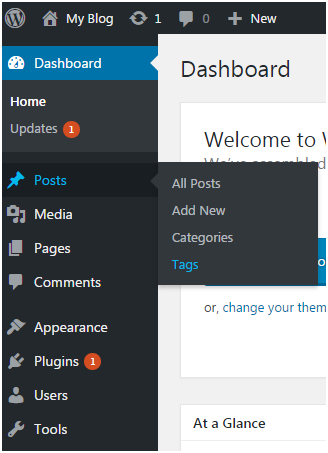
To add a tag, go to Posts > Tags
Wordpress Wordpress tags2

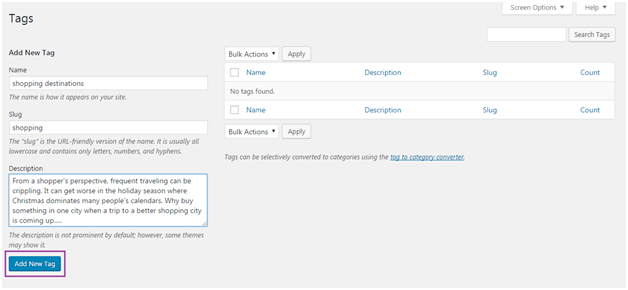
Look at the above snapshot, here you have to fill all the fields.

Name - Name of tag which must be unique. Here it is shopping destinations.

Slug - It describes a post in URL. It is generally in lowercase and contains only letters, numbers and hyphens. Here our slug it shopping.

Description - It is a brief intro about the tag. When you hover (bring pointer over the tag) the tag, this description is displayed.

After filling all the above information, click on Add New Tag button.

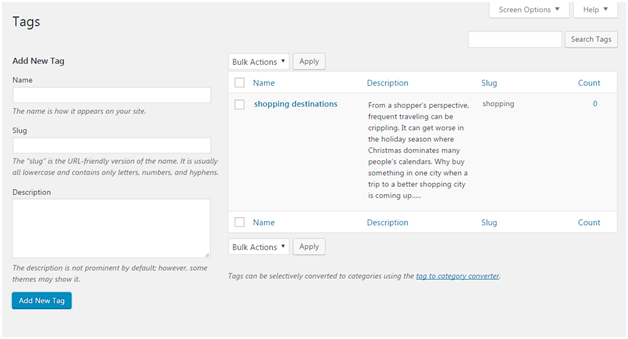
Following screen will appear in front of you.
Wordpress Wordpress tags3

Look at the above snapshot, on the right side, created tag is displayed.


How to Edit Tag

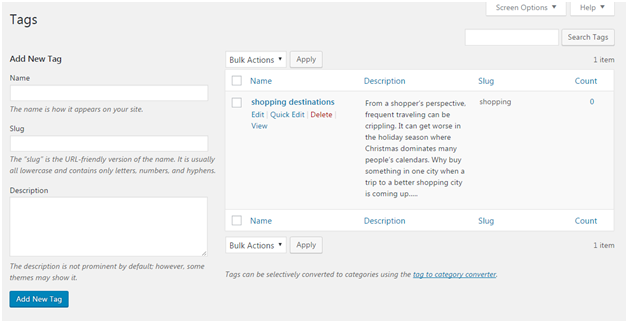
To edit a tag, go to Posts > Tag and bring the mouse over the tag.
Wordpress Wordpress tags4

Look at the above snapshot, two options to edit are there.

On clicking Edit, following page will appear.
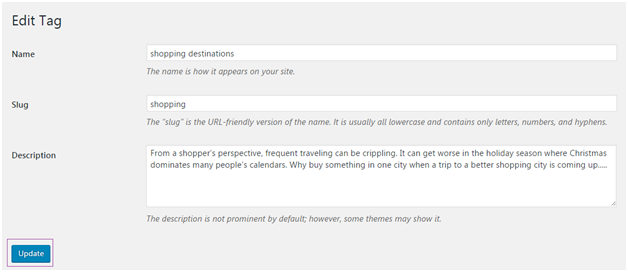
Wordpress Wordpress tags5

Look at the above snapshot, after editing click on Update button.

On clicking Quick Edit, following page will appear.
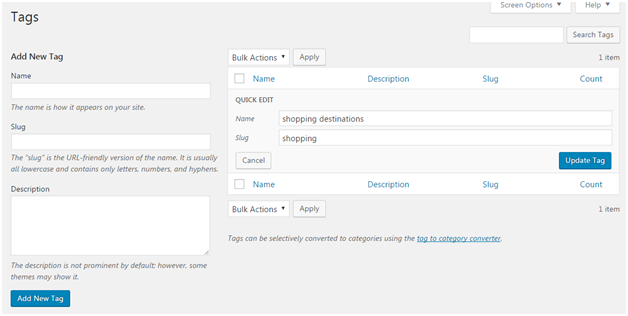
Wordpress Wordpress tags6

Look at the above snapshot, here you can only edit Name and Slug of the tag. After editing, click on Update Tag button.


How to Delete Tag

To delete a tag, go to Post > Tag and bring the mouse over the tag.
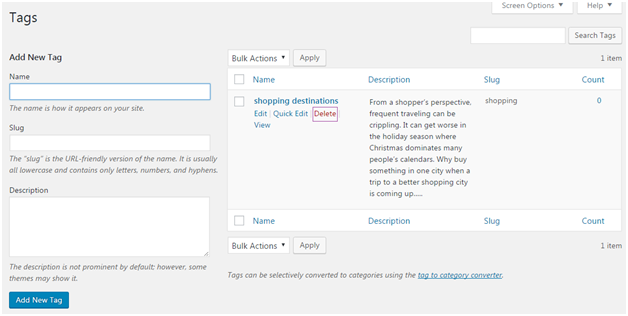
Wordpress Wordpress tags7

Look at the above snapshot, click on Delete option and your Tag will be deleted.


  • Share This:  
  •  Facebook
  •  Twitter
  •  Google+
  •  Stumble
  •  Digg
Email ThisBlogThis!Share to XShare to Facebook
Newer Post Older Post Home

0 comments:

Post a Comment

Thanks

Meta

Popular Posts

  • How to monitor process status during process lifetime
    I need to track the process status ps axf during executable lifetime. Let's say I have executable main.exec and want to store into a fi...
  • How to use Filament 3 with Laravel 11 | Beginner Course
    How to install filament 3 from scratch with Laravel 11. submitted by /u/Tilly-w-e [link] [comments]
  • How to Run a Python File on a Specific Virtual Desktop Only?
    I want to run a Python script on a specific virtual desktop without affecting other desktops. Currently, when I execute my Python file us...
  • How to create a responsive circle with two lines of text in HTML and CSS?
    body { display: flex; justify-content: center; align-items: center; gap: 15px; } .circle { display: flex; flex-direction: col...
  • Clang not generating debug info on -g flag
      1 Answer Active     Oldest  Votes 5 On Windows, Clang is not self-sufficient (at least not the official binaries). You need to have either...

Categories

  • Ajax (26)
  • Bootstrap (30)
  • DBMS (42)
  • HTML (12)
  • HTML5 (45)
  • JavaScript (10)
  • Jquery (34)
  • Jquery UI (2)
  • JqueryUI (32)
  • Laravel (1017)
  • Laravel Tutorials (23)
  • Laravel-Question (6)
  • Magento (9)
  • Magento 2 (95)
  • MariaDB (1)
  • MySql Tutorial (2)
  • PHP-Interview-Questions (3)
  • Php Question (13)
  • Python (36)
  • RDBMS (13)
  • SQL Tutorial (79)
  • Vue.js Tutorial (69)
  • Wordpress (150)
  • Wordpress Theme (3)
  • codeigniter (108)
  • oops (4)
  • php (853)

Social Media Links

  • Follow on Twitter
  • Like on Facebook
  • Subscribe on Youtube
  • Follow on Instagram

Pages

  • Home
  • Contact Us
  • Privacy Policy
  • About us

Blog Archive

  • July (4)
  • September (100)
  • August (50)
  • July (56)
  • June (46)
  • May (59)
  • April (50)
  • March (60)
  • February (42)
  • January (53)
  • December (58)
  • November (61)
  • October (39)
  • September (36)
  • August (36)
  • July (34)
  • June (34)
  • May (36)
  • April (29)
  • March (82)
  • February (1)
  • January (8)
  • December (14)
  • November (41)
  • October (13)
  • September (5)
  • August (48)
  • July (9)
  • June (6)
  • May (119)
  • April (259)
  • March (122)
  • February (368)
  • January (33)
  • October (2)
  • July (11)
  • June (29)
  • May (25)
  • April (168)
  • March (93)
  • February (60)
  • January (28)
  • December (195)
  • November (24)
  • October (40)
  • September (55)
  • August (6)
  • July (48)
  • May (2)
  • January (2)
  • July (6)
  • June (6)
  • February (17)
  • January (69)
  • December (122)
  • November (56)
  • October (92)
  • September (76)
  • August (6)

Loading...

Laravel News

Loading...

Copyright © CoderFunda | Powered by Blogger
Design by Coderfunda | Blogger Theme by Coderfunda | Distributed By Coderfunda