CoderFunda
  • Home
  • About us
    • Contact Us
    • Disclaimer
    • Privacy Policy
    • About us
  • Home
  • Php
  • HTML
  • CSS
  • JavaScript
    • JavaScript
    • Jquery
    • JqueryUI
    • Stock
  • SQL
  • Vue.Js
  • Python
  • Wordpress
  • C++
    • C++
    • C
  • Laravel
    • Laravel
      • Overview
      • Namespaces
      • Middleware
      • Routing
      • Configuration
      • Application Structure
      • Installation
    • Overview
  • DBMS
    • DBMS
      • PL/SQL
      • SQLite
      • MongoDB
      • Cassandra
      • MySQL
      • Oracle
      • CouchDB
      • Neo4j
      • DB2
      • Quiz
    • Overview
  • Entertainment
    • TV Series Update
    • Movie Review
    • Movie Review
  • More
    • Vue. Js
    • Php Question
    • Php Interview Question
    • Laravel Interview Question
    • SQL Interview Question
    • IAS Interview Question
    • PCS Interview Question
    • Technology
    • Other

20 February, 2022

Laravel Mail Viewer

 Programing Coderfunda     February 20, 2022     Laravel, Packages, php     No comments   

 avel Mail Viewer is a package by Harish Toshniwal that enables you to view all the mailables in your Laravel application in a single place.

The Design and content team members often need access to the emails your app will be sending out to the users. This is a fairly simple package that makes it possible and tries to minimize developer dependency. By using this package, you can have a dedicated route to view all your mailables at a single place. Having shareable URLs to view the emails makes the team co-ordination more smooth.

I find this idea neat for developers too, because I am always looking through test emails to check out the email, and this package gives you an excellent way to reference all of them in one place.

The configuration is opt-in for the mailables that you want to appear, which means that any new emails you’d like to add you must explicitly define them. You can also constrain accessing mailables by the environment.

Here’s an example of what it looks like from the readme:

Here’s the configuration file at the time of writing:

<?php
return [
/*
|--------------------------------------------------------------------------
| Only the mailables registered here can be accessed using this package
|--------------------------------------------------------------------------
|
| You have to add the mailables including their dependencies
| in the following array. When asked for a mailable, the
| package will search it here for its definition.
|
| Eg: [ new OrderShipped(factory(Order::class)->create()) ]
|
*/
'mailables' => [],
/*
|--------------------------------------------------------------------------
| URL where you want to view the mails
|--------------------------------------------------------------------------
|
| This is the URL where you can view all the
| mailables registered above.
|
*/
'url' => 'mails',
/*
|--------------------------------------------------------------------------
| The environments in which the url should be accessible
|--------------------------------------------------------------------------
|
| If you don't want to use this package in production env
| at all, you can restrict that using this option
| rather than by using a middleware.
|
*/
'allowed_environments' => ['local', 'staging', 'testing'],
/*
|--------------------------------------------------------------------------
| Middlewares that should be applied to the URL
|--------------------------------------------------------------------------
|
| The value should be an array of fully qualified
| class names of the middleware classes.
|
| Eg: [Authenticate::class, CheckForMaintenanceMode::class]
| Don't forget to import the classes at the top!
|
*/
'middlewares' => [],
];
Read More
  • Share This:  
  •  Facebook
  •  Twitter
  •  Google+
  •  Stumble
  •  Digg

Laravel Proximage: A Handy Package for Proxying Images

 Programing Coderfunda     February 20, 2022     Laravel, Packages, php     No comments   


Laravel Proximage is a handy package by Ilya Sakovich for proxying images through images.weserve.nl. The package provides you convenience methods for generating URLs with a fluent API for image transformations.

If you want to cache your images via the images.weserve.nl proxy you can use the proxyimage() helper:

$imageUrl = 'ory.weserv.nl/lichtenstein.jpg';
>>> (string) proximage($imageUrl);
images.weserv.nl/?url=ory.weserv.nl/lichtenstein.jpg

If you wanted to resize the image, you can use the object’s width() method:

$imageUrl = 'ory.weserv.nl/lichtenstein.jpg';
>>> (string) proximage($imageUrl)->width(300);
images.weserv.nl/?url=ory.weserv.nl/lichtenstein.jpg&w=300

And finally, here’s an example of cropping and transforming images:

use Coderello\Proximage\Enums\Parameter;
proximage($imageUrl)
->crop(Parameter\CropAlignment::CENTER)
->transformation(Parameter\Transformation::SQUARE);

The images.weserv.nl service (that this package relies on) uses Cloudflare which means images are cached and delivered from over 150+ global datacenter. You can reference the official documentation for a complete list of transformations available as well as examples of how each setting affects the original source image.

To get complete installation instructions and the latest documentation of the Proximage Laravel package, check out the coderello/laravel-proximage GitHub repository. The Proximage package has tons of transformations available and makes for a quick and easy way to get image transformations within a Laravel project.

Read More
  • Share This:  
  •  Facebook
  •  Twitter
  •  Google+
  •  Stumble
  •  Digg

Laravel Tag Helper

 Programing Coderfunda     February 20, 2022     Laravel, Packages, php     No comments   


Laravel Tag Helper is a package by Marcel Pociot for adding powerful HTML tag helpers to your Laravel application. As a quick example of what this package can do, it ships with a few helpers out of the box.

You might have a typical form with a hidden CSRF input:

<form method="post" action="/profile">
@method('PUT')
@csrf
</form>

With the Laravel Tag Helper package you can write the same as follows:

<form csrf method="put">
{{-- ... --}}
</form>

The output will look like you’d expect:

<form method="post">
<input type="hidden" name="_method" value="PUT">
<input type="hidden" name="_token" value="csrf-token">
</form>

Another built-in helper is the link helper:

<a route="home">Home</a>
<a route="profile" :route-parameters="[$user->id()]">
Home
</a>

Custom Tag Helpers

The package works by registering tag helpers in a service provider’s boot() method. You can target specific elements and attributes that will trigger a process() call on the helper class during rendering.

Here’s an example from the project’s readme:

<?php
namespace BeyondCode\TagHelper\Helpers;
use BeyondCode\TagHelper\Helper;
use BeyondCode\TagHelper\Html\HtmlElement;
class CustomTagHelper extends Helper
{
protected $targetAttribute = 'custom';
protected $targetElement = 'div';
public function process(HtmlElement $element)
{
// Manipulate the DOM element
}
}

Within the process() method you can customize the HTML element tag. For example, if you had a custom element that you wanted to render as a link:

<?php
namespace BeyondCode\TagHelper\Helpers;
use BeyondCode\TagHelper\Helper;
use BeyondCode\TagHelper\Html\HtmlElement;
class CustomLink extends Helper
{
protected $targetElement = 'my-custom-link';
public function process(HtmlElement $element)
{
// Example
// <my-custom-link></my-custom-link>
$element->setTag('a');
$element->setAttribute('href', 'https://laravel-news.com');
}
}
Read More
  • Share This:  
  •  Facebook
  •  Twitter
  •  Google+
  •  Stumble
  •  Digg

Laravel Database Hashing Package

 Programing Coderfunda     February 20, 2022     Laravel, Packages, php     No comments   


The Laravel Database Hashing package is a Laravel +5.5 package by Jack Noordhuis for automatically hashing database attributes. When enabled it automatically hashes data stored in model attributes.

It works by using a trait in combination with a class property:

<?php
use jacknoordhuis\database\hashing\traits\HasHashedAttributes;
class User extends Eloquent {
use HasHashedAttributes;
/**
* The attributes that should be hashed on save.
*
* @var array
*/
protected $hashing = [
"username_lookup",
];
}

Here’s an example from the README that demonstrates using a password as a salt modifier so that the hash can only be re-created when the user provides their valid password:

$user->username_lookup = $user->hashAttribute($username, $password);

You can then find the given user with the following query, using the DatabaseHashing facade provided by this package:

User::where(
"username_lookup",
"=",
\DatabaseHashing::create($request->get("username"), $request->get("password"))
);

I noticed that this package wasn’t ready for Laravel 5.7, which is the latest at the time of writing, but supports Laravel 5.5 and 5.6. If you want to help get this package ready for Laravel 5.7, you can learn about this package on GitHub at JackNoordhuis/laravel-database-hashing.

Read More
  • Share This:  
  •  Facebook
  •  Twitter
  •  Google+
  •  Stumble
  •  Digg

PHP Semantic Versioning Helper

 Programing Coderfunda     February 20, 2022     Laravel, Packages, php     No comments   


SemVer is a semantic versioning helper library for PHP by Chris Kankiewicz with support for parsing, incrementing, and comparison.

Here’s the basic usage which initializes a SemVer\Version object:

use PHLAK\SemVer;
$version = new SemVer\Version(); // Initilializes to '0.1.0'

With an instance of SemVer\Version you can access individual values:

$version = new SemVer\Version('v1.2.3-beta.4+007');
echo $version; // '1.2.3-beta.4+007'
echo $version->major; // 1
echo $version->minor; // 2
echo $version->patch; // 3
echo $version->preRelease; // 'beta.4'
echo $version->build; // '007'

If you wanted to build something that increments your package builds you can use this package’s increment methods:

$version = new SemVer\Version('v1.2.3');
$version->incrementMajor(); // v1.2.3 -> v2.0.0
$version->incrementMinor(); // v1.2.3 -> v1.3.0
$version->incrementPatch(); // v1.2.3 -> v1.2.4

Last, the comparisons are pretty handy:

$version1 = new SemVer('v1.2.3');
$version2 = new SemVer('v3.2.1');
$version1->gt($version2); // false
$version1->lt($version2); // true
$version1->eq($version2); // false
$version1->neq($version2); // true
$version1->gte($version2); // false
$version1->lte($version2); // true

Before checking out this PHLAK/SemVer, I wasn’t aware that composer also has a composer/semver library, which has a comparator and semver class, however, I didn’t find the increment methods found in PHLAK/SemVer.

To get installation instructions, check out PHLAK/SemVer on GitHub!

Read More
  • Share This:  
  •  Facebook
  •  Twitter
  •  Google+
  •  Stumble
  •  Digg

Laravel WebSockets Package Released

 Programing Coderfunda     February 20, 2022     Laravel, Packages, php     No comments   


Laravel WebSockets is a WebSockets server implemented in PHP for your Laravel projects. It’s also a drop-in replacement for Pusher via the Pusher protocol and Laravel Echo JavaScript server, which means all packages that work with Pusher will work with the Laravel WebSockets package.

Running a WebSocket server is at your fingertips with artisan:

php artisan websockets:serve

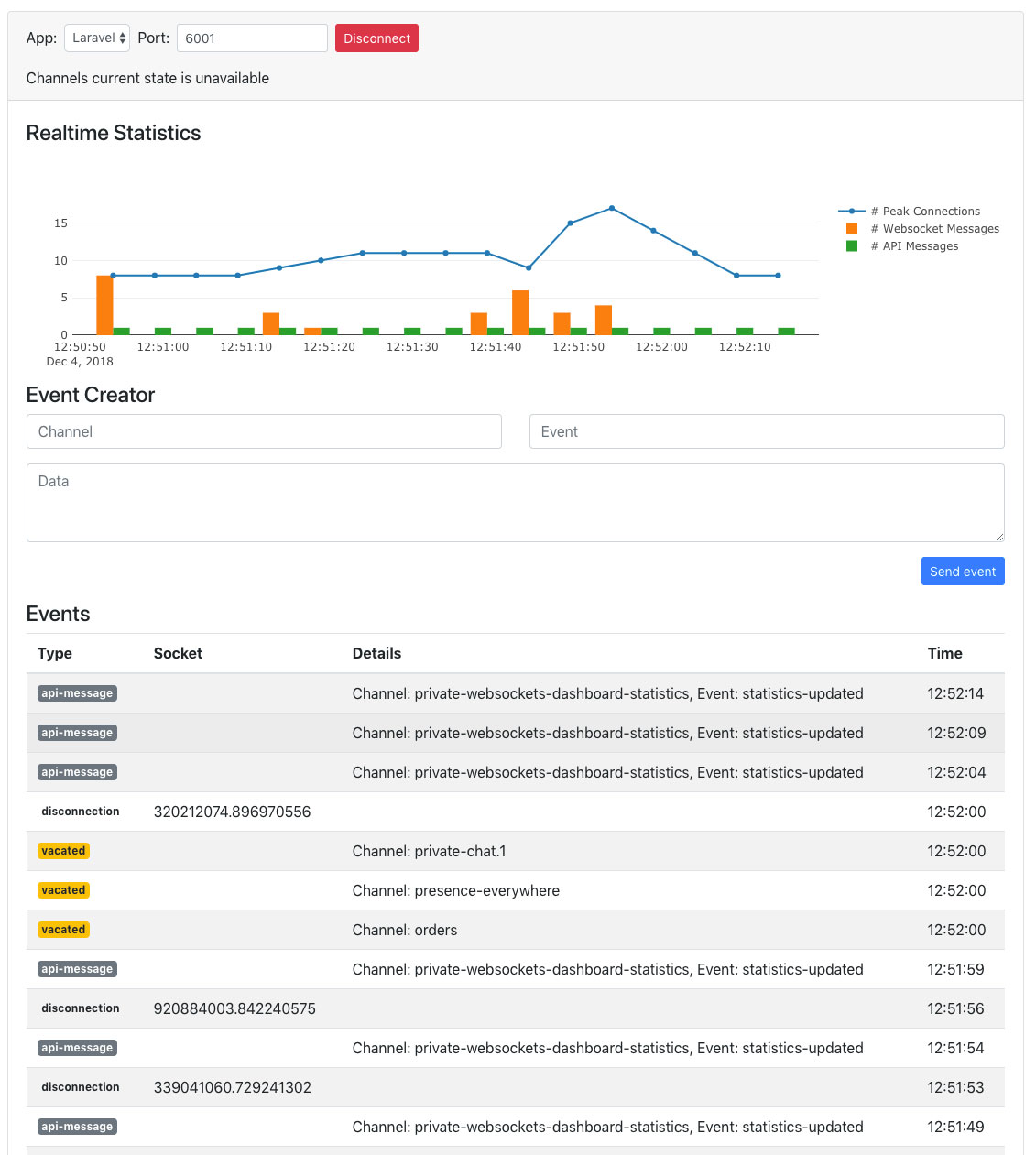
The package also comes with an excellent Debug Dashboard which can help you speed up development of WebSocket features in your applications:

Image credit: Official Debug Dashboard Documentation

The initial Laravel Websockets release is a collaborative effort by Marcel Pociot and Freek Van der Herten. Freek has a very detailed writeup Introducing laravel-websockets, an easy to use WebSocket server implemented in PHP that goes into great detail on the background of the package, how to use it, and many other aspects of the projects.

The documentation includes some benchmarks and the scale looks promising. Of course, your mileage will vary from project-to-project, including your specific application needs and usage patterns.

To learn more about the package and how to use it to check out the Laravel WebSockets documentation. The source code is available on GitHub at beyondcode/laravel-websockets.

Read More
  • Share This:  
  •  Facebook
  •  Twitter
  •  Google+
  •  Stumble
  •  Digg

Accountant Laravel Package

 Programing Coderfunda     February 20, 2022     Laravel, Packages, php     No comments   


Accountant is a Laravel accountably package for your Eloquent models by developer Quetzy Garcia. This package is a convenient way to keep track of Eloquent model changes:

Data discrepancies that may indicate business concerns suspect activities, and other actions that would otherwise pass unnoticed, can now be easily spotted.

At the time of writing, here are the key features according to the README:

  • Many-to-many (BelongsToMany and MorphToMany) relation support;
  • Event source style approach, by keeping complete snapshots of Recordable models when created, modified or retrieved;
  • Ability to recreate Recordable model instances in the exact state they were in when recorded;
  • Signed Ledger records for data integrity;
  • Effortless data integrity checks
  • Recording contexts
  • Huge customisation support
  • Easy to follow documentation and troubleshooting guide;
  • Laravel and Lumen 5.2+ support;

This package has a ton of features you can check it in the documentation. Here’s an example of the “Recordable” trait used to record model events:

<?php
namespace App\Models;
use Altek\Accountant\Contracts\Recordable;
use Illuminate\Database\Eloquent\Model;
class Article extends Model implements Recordable
{
use \Altek\Accountant\Recordable;
// ...
}

Accountant released v1.1.0 on January 1st, which introduced Many-to-many relationships, and forceDelete event support. You can even track pivot events – check the recordable model setup documentation for details on recording pivot events.

You can follow along with Accountant and view the source code on GitLab at Altek / Accountant, including the documentation which is available under version control in the same GitLab repository.

Learn More

Another package that we’ve covered on the topic of event sourcing is Spatie’s Laravel Event Projector. I suggest you read our article that contains links to the concepts around event sourcing if you’re not familiar. I am not sure which features differ between the two packages, but I’d check out both to further determine your needs.

Read More
  • Share This:  
  •  Facebook
  •  Twitter
  •  Google+
  •  Stumble
  •  Digg

Five Hidden Features of the Laravel Excel Package

 Programing Coderfunda     February 20, 2022     Laravel, Packages, php     No comments   


The Laravel Excel package recently celebrated a new milestone of version 3, with new features that help ease advanced use-cases, and is simple to use. Let’s explore some of these hidden features you might not know about, that make Laravel Excel a go-to package for working with Excel.

  1. Exporting from HTML/Blade

Let’s imagine you already have a list page with HTML table:

And here’s the Blade code – resources/views/customers/table.blade.php:

<table class="table">
<thead>
<tr>
<th></th>
<th>First name</th>
<th>Last name</th>
<th>Email</th>
<th>Created at</th>
<th>Updated at</th>
</tr>
</thead>
<tbody>
@foreach ($customers as $customer)
<tr>
<td>{{ $customer->id }}</td>
<td>{{ $customer->first_name }}</td>
<td>{{ $customer->last_name }}</td>
<td>{{ $customer->email }}</td>
<td>{{ $customer->created_at }}</td>
<td>{{ $customer->updated_at }}</td>
</tr>
@endforeach
</tbody>
</table>

You can re-use it to export the same table into Excel.

Step 1. Generate Export class

php artisan make:export CustomersFromView --model=Customer

Step 2. Use FromView to perform the operation.

namespace App\Exports;
use App\Customer;
use Illuminate\Contracts\View\View;
use Maatwebsite\Excel\Concerns\FromView;
class CustomersExportView implements FromView
{
public function view(): View
{
return view('customers.table', [
'customers' => Customer::orderBy('id', 'desc')->take(100)->get()
]);
}
}

Here’s the result Excel file:

Notice: you can export only HTML table, without any layout tags like html, body, div, etc.


  1. Export to PDF, HTML, and others

Although the package is called Laravel Excel, it provides export to more formats. It’s straightforward to use, add one more parameter to the class:

return Excel::download(new CustomersExport(), 'customers.xlsx', 'Html');

Yes, you got it right. HTML. Here’s how it looks:

Not much styling, I know. And here’s the source:

Not only that, it allows to export to PDF, and you can even choose from three libraries for it. Again, all you need to do is specify the format as the last parameter – here’s screenshot from their docs:

Notice: you will also have to install a chosen PDF package via composer, like:

composer require dompdf/dompdf

Here’s how PDF looks like:


  1. Format Cells However You Want

Laravel Excel package has a powerful “parent” – PhpSpreadsheet. So it adopts all the underneath functionality, including cell formatting in various ways.

Here’s how to use it in Laravel Export class, like app/Exports/CustomersExportStyling.php:

Step 1. Use appropriate classes in the header.

use Maatwebsite\Excel\Concerns\WithEvents;
use Maatwebsite\Excel\Events\AfterSheet;

Step 2. Use WithEvents in implements section.

class CustomersExportStyling implements FromCollection, WithEvents
{
// ...

Step 3. Create registerEvents() method with AfterSheet event.

/**
* @return array
*/
public function registerEvents(): array
{
return [
AfterSheet::class => function(AfterSheet $event) {
// ... HERE YOU CAN DO ANY FORMATTING
},
];
}

Here’s an example:

/**
* @return array
*/
public function registerEvents(): array
{
return [
AfterSheet::class => function(AfterSheet $event) {
// All headers - set font size to 14
$cellRange = 'A1:W1';
$event->sheet->getDelegate()->getStyle($cellRange)->getFont()->setSize(14);
// Apply array of styles to B2:G8 cell range
$styleArray = [
'borders' => [
'outline' => [
'borderStyle' => \PhpOffice\PhpSpreadsheet\Style\Border::BORDER_THICK,
'color' => ['argb' => 'FFFF0000'],
]
]
];
$event->sheet->getDelegate()->getStyle('B2:G8')->applyFromArray($styleArray);
// Set first row to height 20
$event->sheet->getDelegate()->getRowDimension(1)->setRowHeight(20);
// Set A1:D4 range to wrap text in cells
$event->sheet->getDelegate()->getStyle('A1:D4')
->getAlignment()->setWrapText(true);
},
];
}

The result of these “random” demo-styling examples looks like this:

All these examples, and many more, you can find in Recipes page of PhpSpreadsheet docs.


  1. Hidden Fields From Model

Let’s imagine we’ve seeded a default Laravel 5.7 users table:

Let’s try to export this one with a simple class FromCollection:

class UsersExport implements FromCollection
{
public function collection()
{
return User::all();
}
}

In the result Excel, you will see some fields missing: password and remember_token:

This is because of this app/User.php property:

class User extends Authenticatable
{
// ...
/**
* The attributes that should be hidden for arrays.
*
* @var array
*/
protected $hidden = [
'password', 'remember_token',
];
}

So, these fields are hidden by default, but it shows us Laravel Excel package behavior – if you want to protect some fields from export, you can do it directly in the model.


  1. Formulas

For some reason, official Laravel Excel package documentation doesn’t mention anything about formulas. But that’s the whole point of using Excel!

Luckily, it’s straightforward to write formulas into our exported file. We need to set cell values like we would to in Excel, for example, =A2+1 or SUM(A1:A10).

One of the ways to do it is to use WithMapping:

use App\Customer;
use Maatwebsite\Excel\Concerns\FromCollection;
use Maatwebsite\Excel\Concerns\WithMapping;
class CustomersExportFormulas implements FromCollection, WithMapping
{
public function collection()
{
return Customer::all();
}
/**
* @var Customer $customer
* @return array
*/
public function map($customer): array
{
return [
$customer->id,
'=A2+1',
$customer->first_name,
$customer->last_name,
$customer->email,
];
}
}

So, these are just five less-known features of Laravel Excel. If you want to find out more, I have a unique online course called Excel Export/Import in Laravel, go check it out!

Read More
  • Share This:  
  •  Facebook
  •  Twitter
  •  Google+
  •  Stumble
  •  Digg

Laravel Mailbox

 Programing Coderfunda     February 20, 2022     Laravel, Packages, php     No comments   


Laravel Mailbox is a package by Marcel Pociot for handling incoming emails in your Laravel application. Mailbox features a fluent API that allows you to define custom mailboxes to catch incoming emails.

Here’s a quick example of an inbound email handler from the documentation:

Mailbox::from('{username}@gmail.com', function (InboundEmail $email, $username) {
// Access email attributes and content
$subject = $email->subject();
$email->reply(new ReplyMailable);
});

Laravel Mailbox works by listening for incoming emails from the supported drivers (options include “mailgun,” “sendgrid,” and “log”) and then responding to them through custom mailbox classes. At a basic level, here’s an example of how you can define a mailbox in a service provider:

use BeyondCode\Mailbox\Facades\Mailbox;
class AppServiceProvider extends ServiceProvider
{
/**
* Bootstrap any application services.
*
* @return void
*/
public function boot()
{
Mailbox::from('sender@domain.com', function (InboundEmail $email) {
// Handle the incoming email
});
}
}

The above example uses a closure, but the second argument can also be an invocable class:

Mailbox::from('sender@domain.com', MyMailbox::class);

By default, this package stores all inbound emails in the database, with a configurable duration to keep them. You can use Laravel’s scheduler with the package’s ‘mailbox:clean’ command, which will remove emails from the database older than the configurable duration to keep them. Check the storing emails documentation for further details.

Out of the box, Mailbox supports Mailgun, Sendgrid, and a local development driver/log. However, you can easily extend/add custom drivers—Laravel Mailbox uses the same manager pattern that is familiar to Laravel users (i.e., database drivers).

To learn more about Laravel Mailbox, you can check out the source code on GitHub at beyondcode/laravel-mailbox. To learn how to install and use the package, check out the Laravel Mailbox documentation.

Read More
  • Share This:  
  •  Facebook
  •  Twitter
  •  Google+
  •  Stumble
  •  Digg

Subdomain Multitenency Package for Laravel

 Programing Coderfunda     February 20, 2022     Laravel, Packages, php     No comments   


Romega Digital released a package to make it easier to create subdomain-based multitenancy in your Laravel applications:

This package is meant to be a quick and easy way to add multitenancy to your Laravel application. It simply creates models and relationships for Tenants and models. The package identifies incoming traffic by subdomain, and finds a corresponding tenant in the Tenant table. If none are found or the user is not associated with a particular subdomain, the user is met with a 403 error.

Remega’s package provides multitenant support to your models through a trait called HasTenants, and also leverages Spatie’s permissions package for some functionality.

Related: Two Best Laravel Packages to Manage Roles/Permissions

Here’s an example from the readme:

use Spatie\Permission\Traits\HasRoles;
use RomegaDigital\Multitenancy\Traits\HasTenants;
use Illuminate\Foundation\Auth\User as Authenticatable;
class User extends Authenticatable
{
use HasTenants, HasRoles;
// ...
}

With the HasTenants trait in place, you can get the users associated with a Tenant model:

User::tenants()->get()

And finally here’s how you create tenants:

Tenant::createMany([
[
'name' => 'An Identifying Name',
'domain' => 'tenant1'
],
[
'name' => 'A Second Customer',
'domain' => 'tenant2'
]
]);

Along with this package, there’s an accompanying Nova package called Multitenency Nova Tool to manage the multitenancy functionality in your application.

To learn more about this Multitenancy package, you can check out the source code on GitHub at romegadigital/Multitenancy. To learn how to install and use the package, check out the Multitenency readme file.

See also: Laravel Tenancy – Multi-Tenant Package for Laravel

Read More
  • Share This:  
  •  Facebook
  •  Twitter
  •  Google+
  •  Stumble
  •  Digg
Newer Posts Older Posts Home

Meta

Popular Posts

  • Generate Migrations from an Existing Database With the Migration Generator Package
    Laravel Migration Generator Migration Generator for Laravel is a package by Bennett Treptow to generate migrations from existing database ...
  • Tailwindcss best practices for responsive design
    Tailwind CSS provides powerful utilities for responsive design out of the box. To use it effectively and maintain clean, scalable code, here...
  • Search Through Models with Laravel Searchable
      Laravel Searchable   is a package by   Spatie   to search through models and other sources pragmatically. Using this package, you can get ...
  • Laravel Razorpay Integration | Payment gateway integration Laravel in 30 mins | Laravel Razorpay
    1 Integration of Razorpay with Laravel. In this tutorial, I have taught how to integrate payment gateway with laravel with mini-project. If...
  • Vue.js Render functions
        Vue.js Render functions Vue.js recommends us to use templates to build HTML. Here, we can use the render function as a closer-to-the-co...

Categories

  • Ajax (26)
  • Bootstrap (30)
  • DBMS (42)
  • HTML (12)
  • HTML5 (45)
  • JavaScript (10)
  • Jquery (34)
  • Jquery UI (2)
  • JqueryUI (32)
  • Laravel (1017)
  • Laravel Tutorials (23)
  • Laravel-Question (6)
  • Magento (9)
  • Magento 2 (95)
  • MariaDB (1)
  • MySql Tutorial (2)
  • PHP-Interview-Questions (3)
  • Php Question (13)
  • Python (36)
  • RDBMS (13)
  • SQL Tutorial (79)
  • Vue.js Tutorial (69)
  • Wordpress (150)
  • Wordpress Theme (3)
  • codeigniter (108)
  • oops (4)
  • php (853)

Social Media Links

  • Follow on Twitter
  • Like on Facebook
  • Subscribe on Youtube
  • Follow on Instagram

Pages

  • Home
  • Contact Us
  • Privacy Policy
  • About us

Blog Archive

  • ▼  2026 (3)
    • ▼  07/26 - 08/02 (2)
      • A stormwater pond in Calgary appears filled with P...
      • Inside Kriti Sanon's duplex sea-facing penthouse w...
    • ►  06/28 - 07/05 (1)
  • ►  2025 (4)
    • ►  07/06 - 07/13 (2)
    • ►  06/29 - 07/06 (2)
  • ►  2024 (486)
    • ►  09/15 - 09/22 (30)
    • ►  09/08 - 09/15 (35)
    • ►  09/01 - 09/08 (35)
    • ►  08/11 - 08/18 (2)
    • ►  08/04 - 08/11 (33)
    • ►  07/28 - 08/04 (30)
    • ►  07/07 - 07/14 (11)
    • ►  06/30 - 07/07 (35)
    • ►  06/23 - 06/30 (5)
    • ►  06/02 - 06/09 (31)
    • ►  05/26 - 06/02 (20)
    • ►  05/05 - 05/12 (29)
    • ►  04/28 - 05/05 (26)
    • ►  04/07 - 04/14 (10)
    • ►  03/31 - 04/07 (34)
    • ►  03/24 - 03/31 (10)
    • ►  03/03 - 03/10 (35)
    • ►  02/25 - 03/03 (15)
    • ►  02/04 - 02/11 (22)
    • ►  01/28 - 02/04 (30)
    • ►  01/07 - 01/14 (8)
  • ►  2023 (484)
    • ►  12/31 - 01/07 (35)
    • ►  12/24 - 12/31 (10)
    • ►  12/03 - 12/10 (33)
    • ►  11/26 - 12/03 (20)
    • ►  11/05 - 11/12 (35)
    • ►  10/29 - 11/05 (20)
    • ►  10/22 - 10/29 (9)
    • ►  10/15 - 10/22 (7)
    • ►  10/08 - 10/15 (9)
    • ►  10/01 - 10/08 (10)
    • ►  09/24 - 10/01 (9)
    • ►  09/17 - 09/24 (9)
    • ►  09/10 - 09/17 (7)
    • ►  09/03 - 09/10 (9)
    • ►  08/27 - 09/03 (9)
    • ►  08/20 - 08/27 (8)
    • ►  08/13 - 08/20 (8)
    • ►  08/06 - 08/13 (8)
    • ►  07/30 - 08/06 (8)
    • ►  07/23 - 07/30 (7)
    • ►  07/16 - 07/23 (8)
    • ►  07/09 - 07/16 (7)
    • ►  07/02 - 07/09 (8)
    • ►  06/25 - 07/02 (7)
    • ►  06/18 - 06/25 (7)
    • ►  06/11 - 06/18 (7)
    • ►  06/04 - 06/11 (11)
    • ►  05/28 - 06/04 (7)
    • ►  05/21 - 05/28 (8)
    • ►  05/14 - 05/21 (11)
    • ►  05/07 - 05/14 (7)
    • ►  04/30 - 05/07 (7)
    • ►  04/23 - 04/30 (8)
    • ►  04/16 - 04/23 (9)
    • ►  04/09 - 04/16 (7)
    • ►  04/02 - 04/09 (4)
    • ►  03/26 - 04/02 (21)
    • ►  03/19 - 03/26 (2)
    • ►  03/12 - 03/19 (9)
    • ►  03/05 - 03/12 (26)
    • ►  02/26 - 03/05 (25)
    • ►  01/15 - 01/22 (7)
    • ►  01/08 - 01/15 (1)
  • ►  2022 (1037)
    • ►  12/11 - 12/18 (13)
    • ►  12/04 - 12/11 (1)
    • ►  11/27 - 12/04 (40)
    • ►  11/06 - 11/13 (1)
    • ►  10/16 - 10/23 (13)
    • ►  09/04 - 09/11 (5)
    • ►  08/21 - 08/28 (24)
    • ►  08/14 - 08/21 (24)
    • ►  07/03 - 07/10 (9)
    • ►  06/19 - 06/26 (3)
    • ►  05/29 - 06/05 (3)
    • ►  05/22 - 05/29 (3)
    • ►  05/15 - 05/22 (109)
    • ►  05/01 - 05/08 (7)
    • ►  04/24 - 05/01 (7)
    • ►  04/17 - 04/24 (64)
    • ►  04/10 - 04/17 (115)
    • ►  04/03 - 04/10 (73)
    • ►  03/27 - 04/03 (77)
    • ►  03/13 - 03/20 (2)
    • ►  03/06 - 03/13 (25)
    • ►  02/27 - 03/06 (18)
    • ►  02/20 - 02/27 (153)
    • ►  02/13 - 02/20 (187)
    • ►  01/30 - 02/06 (45)
    • ►  01/23 - 01/30 (15)
    • ►  01/16 - 01/23 (1)
  • ►  2021 (412)
    • ►  10/24 - 10/31 (2)
    • ►  07/25 - 08/01 (1)
    • ►  07/11 - 07/18 (10)
    • ►  06/13 - 06/20 (29)
    • ►  05/23 - 05/30 (1)
    • ►  05/02 - 05/09 (24)
    • ►  04/25 - 05/02 (24)
    • ►  04/18 - 04/25 (112)
    • ►  04/11 - 04/18 (1)
    • ►  04/04 - 04/11 (6)
    • ►  03/28 - 04/04 (86)
    • ►  03/21 - 03/28 (19)
    • ►  03/14 - 03/21 (2)
    • ►  03/07 - 03/14 (10)
    • ►  02/28 - 03/07 (1)
    • ►  02/21 - 02/28 (29)
    • ►  02/14 - 02/21 (13)
    • ►  02/07 - 02/14 (12)
    • ►  01/31 - 02/07 (6)
    • ►  01/17 - 01/24 (2)
    • ►  01/10 - 01/17 (8)
    • ►  01/03 - 01/10 (14)
  • ►  2020 (376)
    • ►  12/27 - 01/03 (37)
    • ►  12/20 - 12/27 (92)
    • ►  12/13 - 12/20 (29)
    • ►  12/06 - 12/13 (37)
    • ►  11/29 - 12/06 (4)
    • ►  11/15 - 11/22 (14)
    • ►  11/08 - 11/15 (8)
    • ►  11/01 - 11/08 (2)
    • ►  10/18 - 10/25 (14)
    • ►  10/11 - 10/18 (16)
    • ►  10/04 - 10/11 (10)
    • ►  09/20 - 09/27 (10)
    • ►  09/06 - 09/13 (19)
    • ►  08/30 - 09/06 (26)
    • ►  08/23 - 08/30 (4)
    • ►  08/16 - 08/23 (2)
    • ►  07/12 - 07/19 (48)
    • ►  05/17 - 05/24 (2)
    • ►  01/05 - 01/12 (2)
  • ►  2019 (74)
    • ►  07/07 - 07/14 (6)
    • ►  06/16 - 06/23 (6)
    • ►  02/10 - 02/17 (17)
    • ►  01/13 - 01/20 (37)
    • ►  01/06 - 01/13 (8)
  • ►  2018 (376)
    • ►  12/30 - 01/06 (24)
    • ►  12/16 - 12/23 (8)
    • ►  12/09 - 12/16 (98)
    • ►  12/02 - 12/09 (16)
    • ►  11/18 - 11/25 (36)
    • ►  11/04 - 11/11 (18)
    • ►  10/28 - 11/04 (10)
    • ►  10/21 - 10/28 (26)
    • ►  10/14 - 10/21 (52)
    • ►  10/07 - 10/14 (4)
    • ►  09/30 - 10/07 (2)
    • ►  09/23 - 09/30 (68)
    • ►  09/16 - 09/23 (4)
    • ►  09/09 - 09/16 (4)
    • ►  08/26 - 09/02 (6)

Data Publish News

Loading...

Al Jazeera – Breaking News, World News and Video from Al Jazeera

Loading...

Laravel News

Loading...

Copyright © CoderFunda | Powered by Blogger
Design by Coderfunda | Blogger Theme by Coderfunda | Distributed By Coderfunda