CoderFunda
  • Home
  • About us
    • Contact Us
    • Disclaimer
    • Privacy Policy
    • About us
  • Home
  • Php
  • HTML
  • CSS
  • JavaScript
    • JavaScript
    • Jquery
    • JqueryUI
    • Stock
  • SQL
  • Vue.Js
  • Python
  • Wordpress
  • C++
    • C++
    • C
  • Laravel
    • Laravel
      • Overview
      • Namespaces
      • Middleware
      • Routing
      • Configuration
      • Application Structure
      • Installation
    • Overview
  • DBMS
    • DBMS
      • PL/SQL
      • SQLite
      • MongoDB
      • Cassandra
      • MySQL
      • Oracle
      • CouchDB
      • Neo4j
      • DB2
      • Quiz
    • Overview
  • Entertainment
    • TV Series Update
    • Movie Review
    • Movie Review
  • More
    • Vue. Js
    • Php Question
    • Php Interview Question
    • Laravel Interview Question
    • SQL Interview Question
    • IAS Interview Question
    • PCS Interview Question
    • Technology
    • Other

04 April, 2022

Data model Schema and Instance

 Programing Coderfunda     April 04, 2022     DBMS     No comments   


Data model Schema and Instance

  • The data which is stored in the database at a particular moment of time is called an instance of the database.
  • The overall design of a database is called schema.
  • A database schema is the skeleton structure of the database. It represents the logical view of the entire database.
  • A schema contains schema objects like table, foreign key, primary key, views, columns, data types, stored procedure, etc.
  • A database schema can be represented by using the visuala diagram. That diagram shows the database objects and their relationship with each other.
  • A database schema is designed by the database designers to help programmers whose software will interact with the database. The process of database creation is called data modeling.

A schema diagram can display only some aspects of a schema like the name of record type, data type, and constraints. Other aspects can't be specified through the schema diagram. For example, the given figure neither shows the data type of each data item nor the relationship among various files.

In the database, actual data changes quite frequently. For example, in the given figure, the database changes whenever we add a new grade or add a student. The data at a particular moment is called the instance of the database.
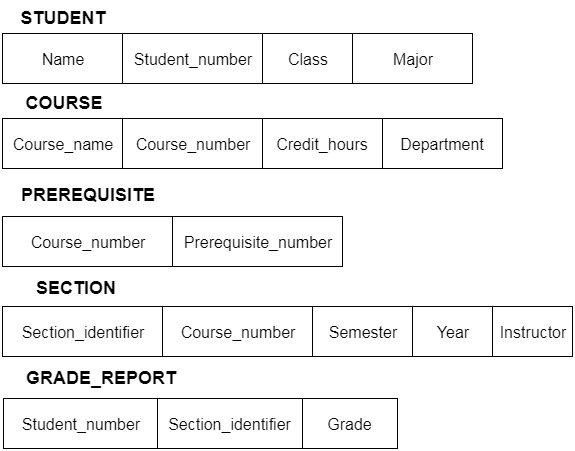
DBMS Data model Schema and Instance
  • Share This:  
  •  Facebook
  •  Twitter
  •  Google+
  •  Stumble
  •  Digg
Email ThisBlogThis!Share to XShare to Facebook
Newer Post Older Post Home

0 comments:

Post a Comment

Thanks

Meta

Popular Posts

  • Vue.js Events
      In Vue.js, Events are used to respond to an action. Suppose, you have to build a dynamic website using Vue.js then you'll most likely ...
  • Spring Security PreAuthorize using multi-value enum
    I have a annotation that is declared as follows. @Retention(RetentionPolicy.RUNTIME) @Target(ElementType.METHOD) @PreAuthorize("hasA...
  • Running PHPStan on max with Laravel
      Over the last few years static analysis in PHP, and more specifically Laravel, has become more and more popular. With more people adopting...
  • Generalization
    Generalization Generalization is like a bottom-up approach in which two or more entities of lower-level levels combine to form a higher-leve...
  • Blade Component to Serve Images and Download Files
      Smart   makes it possible to serve images and download files from any location, including Laravel disks within a Laravel application. It e...

Categories

  • Ajax (26)
  • Bootstrap (30)
  • DBMS (42)
  • HTML (12)
  • HTML5 (45)
  • JavaScript (10)
  • Jquery (34)
  • Jquery UI (2)
  • JqueryUI (32)
  • Laravel (1017)
  • Laravel Tutorials (23)
  • Laravel-Question (6)
  • Magento (9)
  • Magento 2 (95)
  • MariaDB (1)
  • MySql Tutorial (2)
  • PHP-Interview-Questions (3)
  • Php Question (13)
  • Python (36)
  • RDBMS (13)
  • SQL Tutorial (79)
  • Vue.js Tutorial (69)
  • Wordpress (150)
  • Wordpress Theme (3)
  • codeigniter (108)
  • oops (4)
  • php (853)

Social Media Links

  • Follow on Twitter
  • Like on Facebook
  • Subscribe on Youtube
  • Follow on Instagram

Pages

  • Home
  • Contact Us
  • Privacy Policy
  • About us

Blog Archive

  • July (4)
  • September (100)
  • August (50)
  • July (56)
  • June (46)
  • May (59)
  • April (50)
  • March (60)
  • February (42)
  • January (53)
  • December (58)
  • November (61)
  • October (39)
  • September (36)
  • August (36)
  • July (34)
  • June (34)
  • May (36)
  • April (29)
  • March (82)
  • February (1)
  • January (8)
  • December (14)
  • November (41)
  • October (13)
  • September (5)
  • August (48)
  • July (9)
  • June (6)
  • May (119)
  • April (259)
  • March (122)
  • February (368)
  • January (33)
  • October (2)
  • July (11)
  • June (29)
  • May (25)
  • April (168)
  • March (93)
  • February (60)
  • January (28)
  • December (195)
  • November (24)
  • October (40)
  • September (55)
  • August (6)
  • July (48)
  • May (2)
  • January (2)
  • July (6)
  • June (6)
  • February (17)
  • January (69)
  • December (122)
  • November (56)
  • October (92)
  • September (76)
  • August (6)

Loading...

Laravel News

Loading...

Copyright © CoderFunda | Powered by Blogger
Design by Coderfunda | Blogger Theme by Coderfunda | Distributed By Coderfunda