CoderFunda
  • Home
  • About us
    • Contact Us
    • Disclaimer
    • Privacy Policy
    • About us
  • Home
  • Php
  • HTML
  • CSS
  • JavaScript
    • JavaScript
    • Jquery
    • JqueryUI
    • Stock
  • SQL
  • Vue.Js
  • Python
  • Wordpress
  • C++
    • C++
    • C
  • Laravel
    • Laravel
      • Overview
      • Namespaces
      • Middleware
      • Routing
      • Configuration
      • Application Structure
      • Installation
    • Overview
  • DBMS
    • DBMS
      • PL/SQL
      • SQLite
      • MongoDB
      • Cassandra
      • MySQL
      • Oracle
      • CouchDB
      • Neo4j
      • DB2
      • Quiz
    • Overview
  • Entertainment
    • TV Series Update
    • Movie Review
    • Movie Review
  • More
    • Vue. Js
    • Php Question
    • Php Interview Question
    • Laravel Interview Question
    • SQL Interview Question
    • IAS Interview Question
    • PCS Interview Question
    • Technology
    • Other

28 March, 2022

How to install WordPress plugins

 Programing Coderfunda     March 28, 2022     Wordpress     No comments   


How to install WordPress plugins

Installing plugins will provide extra functionality to your site. To install a plugin, you just need to put the plugin file into your wordpress file. After installation, you may activate it or deactivate it.

There are three methods from which you can install plugins.

  • Installing plugin using search
  • Installing plugin using uploading
  • Installing plugin manually using FTP

Here, we'll discuss all three methods.


Installing plugin using search

This method is only available for the free plugins because search is applicable for the WordPress directory only.

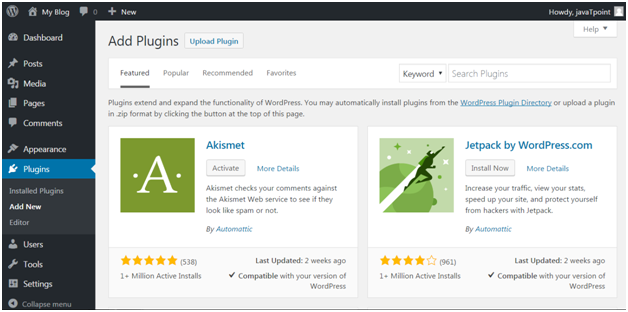
Login to your WordPress, and go to Plugins > Add New.
Wordpress How-to-install-plugin1

Look at the above snapshot, this page will be displayed. Here in the search option, you can give a plugin name the function name for which you want that plugin.

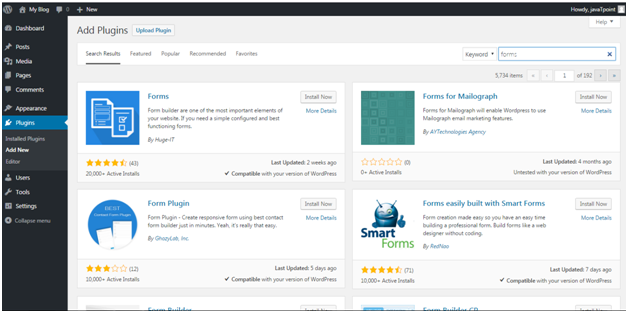
For example, we are searching for form plugin.
Wordpress How-to-install-plugin2

Look at the above snapshot, results related to our search is displayed with a list of matching plugins. We can select a plugin matching our criteria.

Once you have selected a plugin, click on Install Now button. Your plugin will be installed but to activate it you have to click on Activate button.


Installing plugin using uploading

From this method paid plugins can also be installed.

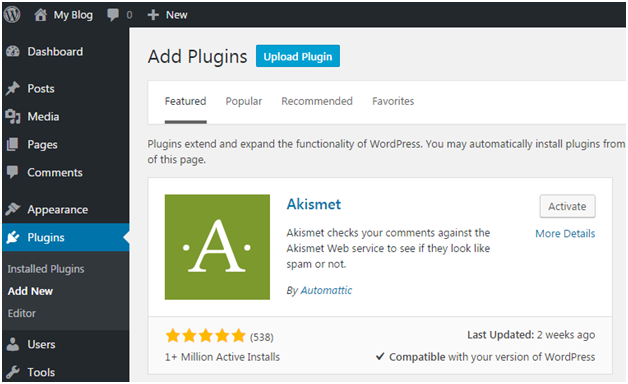
First of all, download a plugin file from the source which will be in zip format. Now go to Plugins > Add New page.
Wordpress How-to-install-plugin3

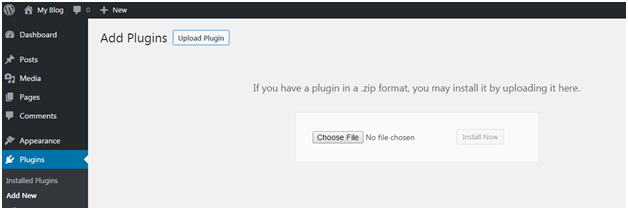
Look at the above snapshot, click on Upload Plugin. It will bring you to the following page.
Wordpress How-to-install-plugin4

Look at the above snapshot, here you have to choose the downloaded plugin file and click on Install Now.
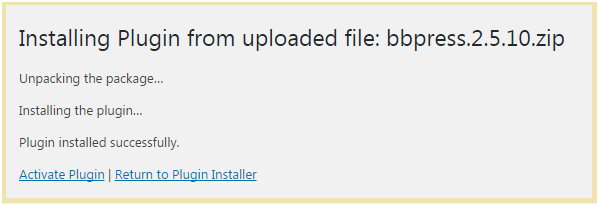
Wordpress How-to-install-plugin5

Look at the above snapshot, plugin has successfully installed showing a message. To activate this plugin you need to activate it.


  • Share This:  
  •  Facebook
  •  Twitter
  •  Google+
  •  Stumble
  •  Digg
Email ThisBlogThis!Share to XShare to Facebook
Newer Post Older Post Home

0 comments:

Post a Comment

Thanks

Meta

Popular Posts

  • Running PHPStan on max with Laravel
      Over the last few years static analysis in PHP, and more specifically Laravel, has become more and more popular. With more people adopting...
  • Spring Security PreAuthorize using multi-value enum
    I have a annotation that is declared as follows. @Retention(RetentionPolicy.RUNTIME) @Target(ElementType.METHOD) @PreAuthorize("hasA...
  • CodeIgniter - Form Validation
    Validation is an important process while building web application. It ensures that the data that we are getting is proper and valid to store...
  • SQL UPDATE Statement
      The SQL UPDATE Statement The UPDATE statement is used to modify the existing records in a table. UPDATE Syntax UPDATE   table_name SET   c...
  • Automaticall generate pass through to child object function
    I would like to automatically forward a function call to a child in python, so that the parent class has said function and then forwards the...

Categories

  • Ajax (26)
  • Bootstrap (30)
  • DBMS (42)
  • HTML (12)
  • HTML5 (45)
  • JavaScript (10)
  • Jquery (34)
  • Jquery UI (2)
  • JqueryUI (32)
  • Laravel (1017)
  • Laravel Tutorials (23)
  • Laravel-Question (6)
  • Magento (9)
  • Magento 2 (95)
  • MariaDB (1)
  • MySql Tutorial (2)
  • PHP-Interview-Questions (3)
  • Php Question (13)
  • Python (36)
  • RDBMS (13)
  • SQL Tutorial (79)
  • Vue.js Tutorial (69)
  • Wordpress (150)
  • Wordpress Theme (3)
  • codeigniter (108)
  • oops (4)
  • php (853)

Social Media Links

  • Follow on Twitter
  • Like on Facebook
  • Subscribe on Youtube
  • Follow on Instagram

Pages

  • Home
  • Contact Us
  • Privacy Policy
  • About us

Blog Archive

  • July (4)
  • September (100)
  • August (50)
  • July (56)
  • June (46)
  • May (59)
  • April (50)
  • March (60)
  • February (42)
  • January (53)
  • December (58)
  • November (61)
  • October (39)
  • September (36)
  • August (36)
  • July (34)
  • June (34)
  • May (36)
  • April (29)
  • March (82)
  • February (1)
  • January (8)
  • December (14)
  • November (41)
  • October (13)
  • September (5)
  • August (48)
  • July (9)
  • June (6)
  • May (119)
  • April (259)
  • March (122)
  • February (368)
  • January (33)
  • October (2)
  • July (11)
  • June (29)
  • May (25)
  • April (168)
  • March (93)
  • February (60)
  • January (28)
  • December (195)
  • November (24)
  • October (40)
  • September (55)
  • August (6)
  • July (48)
  • May (2)
  • January (2)
  • July (6)
  • June (6)
  • February (17)
  • January (69)
  • December (122)
  • November (56)
  • October (92)
  • September (76)
  • August (6)

Loading...

Laravel News

Loading...

Copyright © CoderFunda | Powered by Blogger
Design by Coderfunda | Blogger Theme by Coderfunda | Distributed By Coderfunda